The IKEA Effect in Reverse - Why Handmade Leather Feels More Valuable Than DIY
The moment someone opens a package containing a handmade leather wallet, something shifts. The weight feels different. The texture demands attention. Even the smell - that unmistakable scent of vegetable-tanned leather - communicates value before a single card slides into place.
This reaction contradicts what behavioral economists call the IKEA effect: the cognitive bias that makes people overvalue things they've built themselves. Assemble a bookshelf from flat-pack components, and suddenly it feels more valuable than an identical pre-assembled version. The effort invested creates emotional attachment, even when the result is objectively inferior.
Yet with leather goods, the opposite happens. A hand-stitched wallet consistently feels more valuable than any DIY leather kit, regardless of how much time someone spends cutting, punching, and stitching their own version. The question isn't whether this perception exists - it's why it persists so strongly in an era that celebrates maker culture and customization.
What the IKEA Effect Actually Measures
The original research by Norton, Mochon, and Ariely (2012) demonstrated that labor alone increases valuation. Study participants who assembled IKEA boxes valued their creations 63% higher than identical pre-assembled versions. The effort created what psychologists call effort justification - the need to believe that hard work produces proportionally valuable results.
But the research revealed critical limitations. The effect only held when assembly succeeded. Failed attempts destroyed value perception entirely. Participants who couldn't complete their IKEA furniture valued it less than the pre-assembled version, even when the incomplete project represented hours of effort.
This success requirement matters tremendously for leather goods. DIY leather kits promise the satisfaction of creation, but the skill floor is high. Uneven stitching shows. Poorly beveled edges catch on pockets. Imprecise cuts create asymmetry that worsens with use.
Why Leather Work Reveals Skill Gaps Immediately
A wobbly bookshelf still holds books. An unevenly stitched wallet fails its basic function within weeks. The difference comes down to stress points and material memory.
Full-grain leather is unforgiving. Every cut, every stitch hole, every burnished edge either enhances or compromises structural integrity. Unlike wood or metal, leather is a skin - it has grain direction, density variations, and natural characteristics that demand responsive technique rather than following instructions.
Consider saddle stitching, the foundation of durable leather construction. The technique requires maintaining consistent tension across dozens of holes while ensuring the thread locks properly at each junction. Too loose, and the stitching gaps under stress. Too tight, and the thread cuts through the leather over time.
Professional leather workers develop this tension sense through thousands of repetitions. DIY enthusiasts following YouTube tutorials struggle to maintain consistency across even a single seam. The wallet might look acceptable initially, but six months of daily use exposes every tension inconsistency as the stitching loosens unevenly.
The Craft Knowledge Gap
When someone examines a card holder from an experienced maker, they're looking at decisions that don't appear in any instruction manual. The leather thickness balances flexibility with structure. The edge finishing creates smooth transitions that prevent pocket wear. The stitch spacing accounts for the specific leather temper and expected use patterns.
These aren't arbitrary choices - they're solutions to problems most DIY makers don't yet know exist. A beginner selecting leather for their first wallet project sees color and texture. An experienced craftsman evaluates fiber density, oil content, tannage quality, and how the specific hide will respond to edge burnishing techniques.
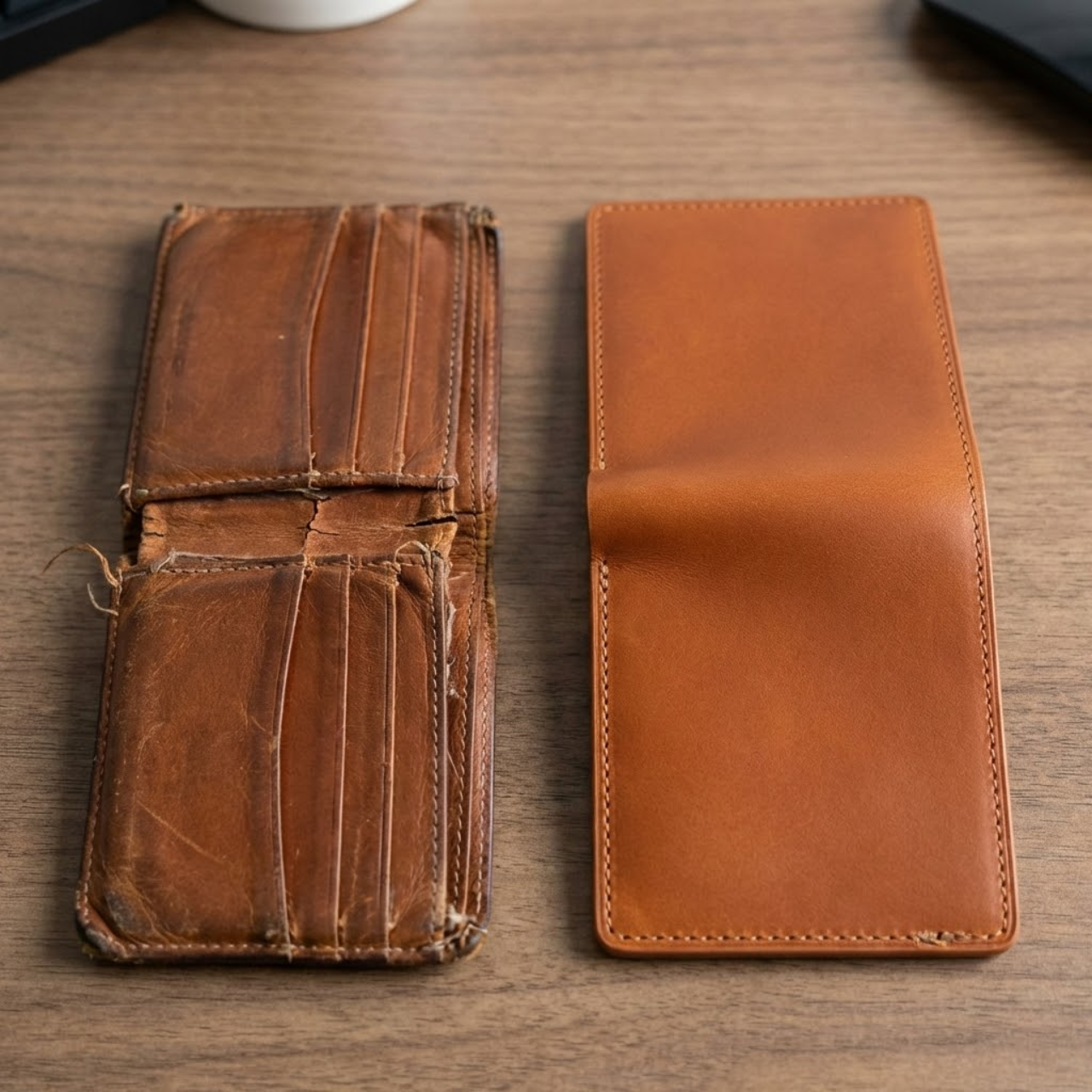
This knowledge gap explains why DIY leather goods often disappoint after the initial pride of completion fades. The wallet works, technically. But it doesn't develop the rich patina of properly selected leather. The edges darken unevenly or fray. The structure loosens in ways that feel cheap rather than broken-in.
Material Quality as an Invisible Multiplier
Professional leather workers source materials most hobbyists never encounter. The difference between craft store leather and the full-grain vegetable-tanned leather used in premium goods isn't subtle - it's foundational.
Craft store leather is typically chrome-tanned, corrected-grain material selected for consistency and ease of working rather than aging characteristics. It cuts easily, stitches predictably, and looks acceptable when new. But it doesn't develop patina. The surface coating prevents the natural darkening and character development that makes leather goods more beautiful with age.
Compare this to the leather used in bifold wallets from serious makers. Vegetable-tanned full-grain leather retains the complete surface layer of the hide, including all the natural grain variation and fiber density that creates durability. The tanning process uses natural tannins from tree bark rather than chromium salts, resulting in leather that darkens and develops character through oxidation and oil absorption.
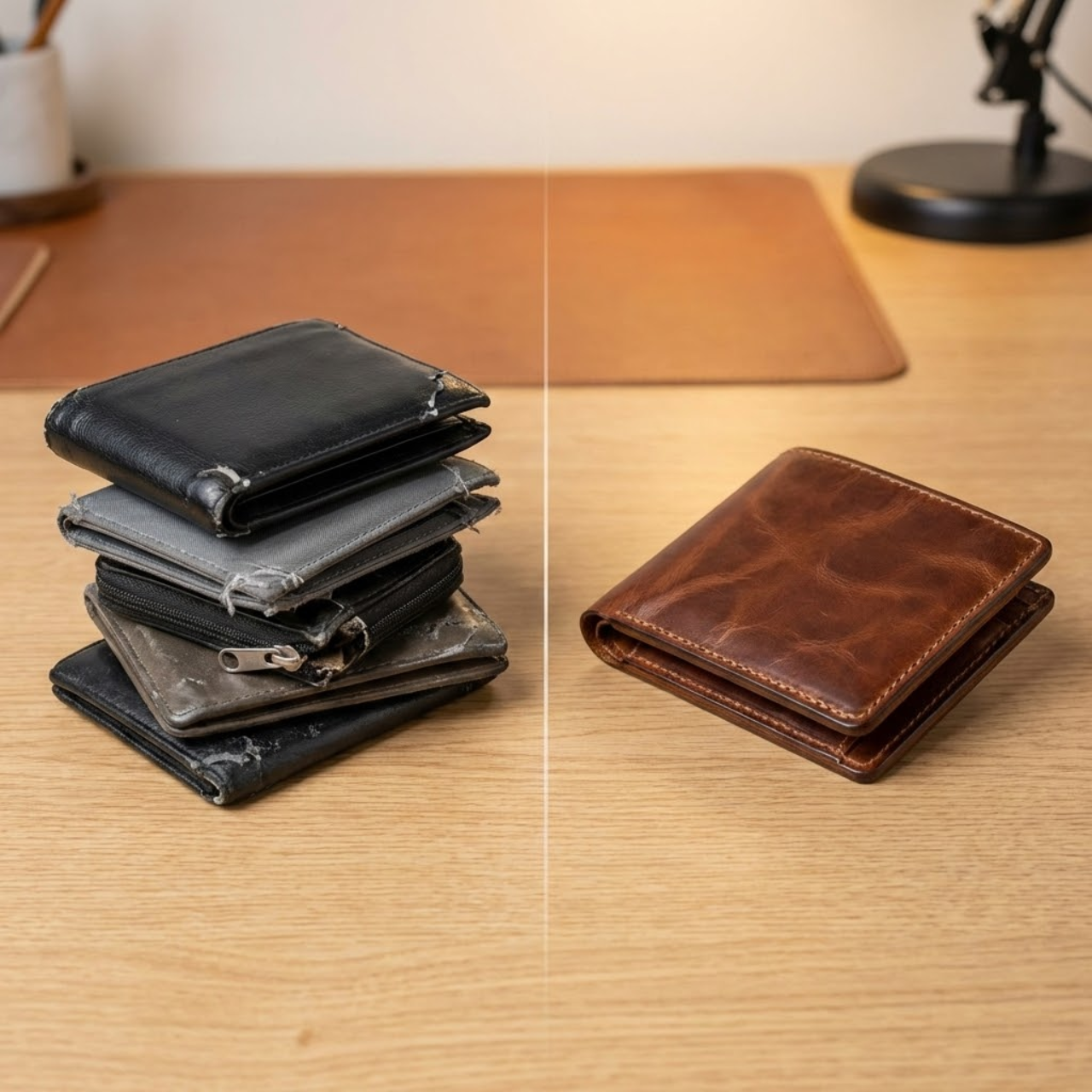
A DIY wallet made from craft store leather might cost $30 in materials and ten hours of work. But five years later, it looks like a five-year-old craft project. A professionally made wallet from quality leather looks like an heirloom that's just getting started. Lost Dutchman Leather demonstrates this artisan craftsmanship value through leather selection that prioritizes decades of beautiful aging over immediate perfection.
The Patina Problem
Here's where the reverse handmade leather IKEA effect becomes most visible. Leather goods increase in perceived value as they age - but only if they age well. Poor materials or construction create wear patterns that look damaged rather than distinguished.
Professional makers select leather that darkens evenly, develops rich color depth, and shows handling marks as character rather than deterioration. They orient cuts to account for grain direction and natural variation. They finish edges in ways that seal the fiber structure while allowing the leather to breathe and develop patina naturally.
DIY makers working from kits get pre-cut pieces optimized for ease of assembly, not aging characteristics. The leather might be positioned to minimize visible imperfections when new, but this often means grain direction runs perpendicular to stress points. Six months of use creates cracking rather than character lines.
The person who spent ten hours hand-stitching their wallet watches it deteriorate while their friend's professionally made wallet grows more attractive. The effort justification that should create the IKEA effect instead amplifies disappointment.
When Handmade Means Hand-Mastered
The term handmade has become marketing noise. Everything from factory-assembled goods with one hand-finished detail to genuine one-person craft operations claims the label. But actual handmade leather work - the kind where a single craftsman cuts, prepares, stitches, and finishes each piece - represents something categorically different from DIY assembly.
Quality design eliminates unnecessary complexity while maximizing durability through precisely scored and folded leather that holds its shape through material memory and structural geometry. Creating this requires understanding exactly how the specific leather will respond to scoring depth, fold radius, and long-term compression.
No DIY kit can replicate this because the knowledge required exceeds what instructions can convey. The maker must evaluate the individual hide, adjust techniques based on that specific leather's characteristics, and make dozens of micro-decisions that collectively determine whether the wallet functions as intended or falls apart.
This is why handmade goods from master craftspeople command premium prices while DIY results often get abandoned in drawers. The IKEA effect assumes effort equals value, but leather work proves that skilled effort creates exponentially more value than unskilled effort, regardless of time invested.
The Sensory Difference
Touch a DIY leather wallet, then touch a professionally made one. The difference registers immediately, even for people who can't articulate what they're feeling. The professional piece has edge finishing smooth enough that fingers glide across transitions. The leather temper balances flexibility with structure. The stitching sits flush with the surface rather than creating ridges.
These tactile qualities communicate value at a subconscious level. Humans evolved to assess material quality through touch - we can detect surface variations measured in microns. When someone handles a leather wallet multiple times daily, these micro-sensations accumulate into overall quality perception.
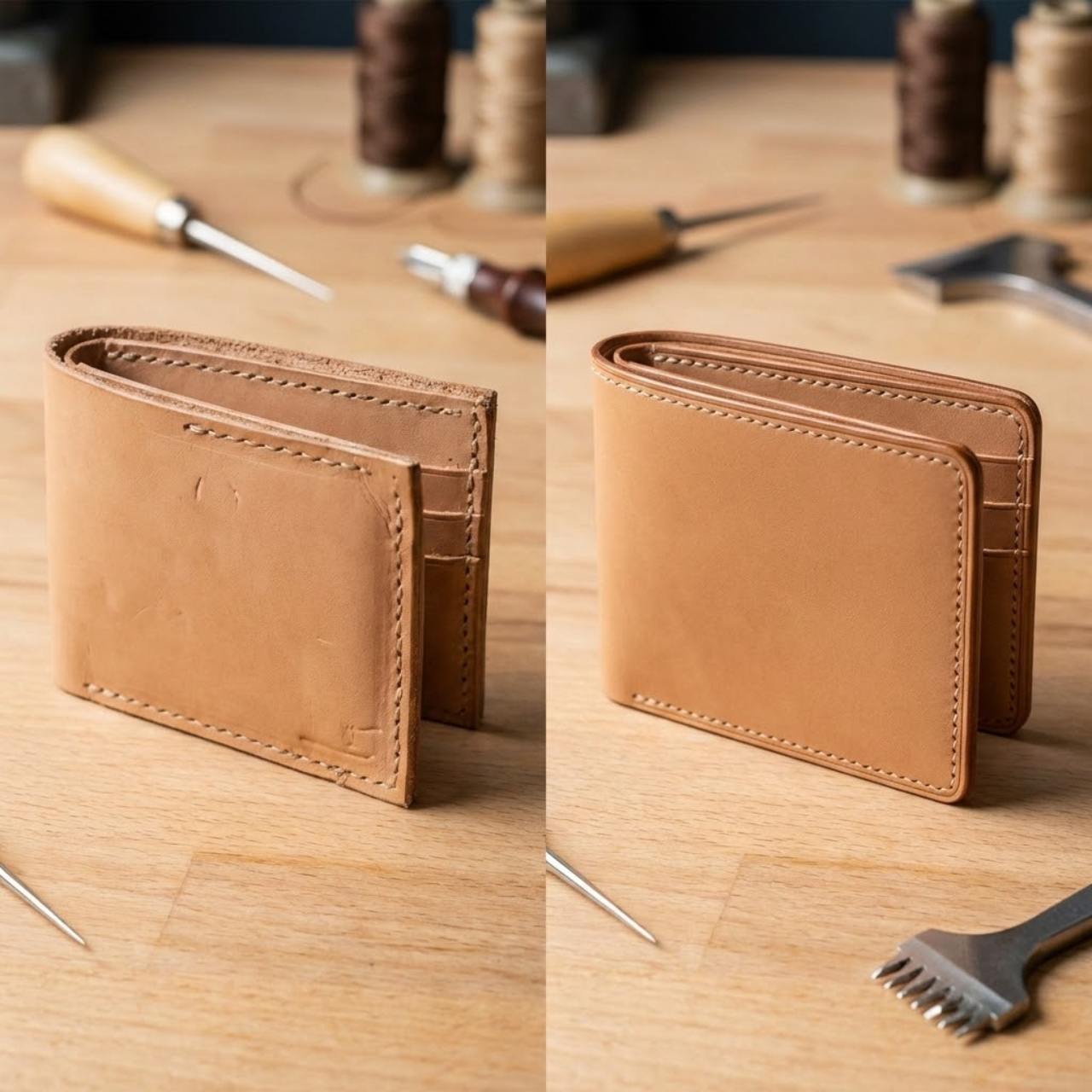
DIY leather goods rarely achieve this sensory refinement. Edge finishing requires specific tools, techniques, and materials that most hobbyists lack. Even when DIY makers invest in proper edge bevelers and burnishing tools, developing the technique to use them effectively takes hundreds of practice repetitions.
The result is goods that look handmade in the negative sense - rough edges, visible construction compromises, and tactile feedback that constantly reminds the user this is amateur work. The effort invested doesn't create value; it creates a daily reminder of the gap between aspiration and execution.
Why Minimalist Design Amplifies the Gap
Simple designs are deceptively difficult. A minimalist card holder with clean lines and minimal stitching offers nowhere to hide mistakes. Every edge must be perfect. Every stitch must maintain consistent tension. The leather selection must account for how the piece will flex and compress with daily use.
Complex designs with decorative tooling, multiple pockets, and elaborate stitching patterns actually forgive minor execution flaws. The visual complexity distracts from small imperfections. Minimalist work offers no such mercy - it succeeds completely or fails obviously.
This is why professional minimalist leather goods command such premium prices. The apparent simplicity requires master-level execution. Three pieces of leather and a dozen stitches must be absolutely perfect because there's nothing else to look at.
DIY makers often gravitate toward minimalist designs thinking they'll be easier. The opposite is true. That simple card sleeve that looks straightforward reveals every skill gap: uneven stitching, imperfect edge finishing, poor leather selection, inconsistent tension. The IKEA effect can't salvage a piece that announces its flaws every time it comes out of a pocket.
The Economics of Mastery
A professional leather worker might spend $50 in materials and three hours creating a wallet that sells for $200. A DIY enthusiast spends $30 in materials and ten hours creating something worth $20. The economics seem backward until you account for the value of mastery.
Those three professional hours represent not just the current construction time but thousands of hours of skill development. The leather selection draws on experience with hundreds of hides. The construction technique reflects solutions to problems encountered across hundreds of previous projects. The finishing work applies muscle memory developed through repetitive practice that can't be shortcut.
The DIY maker's ten hours represent learning time - valuable for skill development but not for creating value in the finished object. The result might be worth $20, but the learning experience is worth far more. The problem occurs when people expect the IKEA effect to bridge this gap, believing their effort should make the DIY wallet feel as valuable as the professional one.
When DIY Actually Works
None of this means DIY leather work lacks value. The process teaches material properties, construction logic, and appreciation for craft skill. Many professional leather workers started with DIY kits and gradually developed their expertise.
But the path from DIY to professional quality requires hundreds of hours of deliberate practice, material experimentation, and skill refinement. The person who makes one wallet from a kit shouldn't expect it to rival work from someone who's made a thousand wallets.
The IKEA effect works for that first DIY project because the maker values the learning experience and the pride of completion. The reverse IKEA effect kicks in when comparing that DIY project to professional work - suddenly the skill gap becomes obvious, and the handmade piece from a master craftsman feels significantly more valuable despite requiring no personal effort.
The Heirloom Factor
Quality leather wallets improve with age and use. A well-made wallet becomes more valuable over time as it develops patina, conforms to its owner's carry pattern, and accumulates the subtle character marks that distinguish personal items from mass-produced goods.
This aging potential multiplies perceived value because it promises future worth, not just current utility. The buyer isn't purchasing a wallet - they're purchasing a decade-long relationship with an object that will grow more distinctive and personal over time.
DIY leather goods rarely achieve this heirloom quality. The construction compromises that seem minor when new become failure points as the piece ages. The material choices that looked acceptable initially reveal themselves as inadequate when the leather doesn't develop attractive patina. The pride of creation fades as the object deteriorates rather than improves.
The reverse IKEA effect strengthens over time. That professionally made wallet keeps getting better, while the DIY version keeps reminding its maker of the gap between their current skill and master-level execution.
Why This Matters for Buying Decisions
Understanding the reverse IKEA effect clarifies why premium handmade leather goods justify their cost. The price reflects not just current construction time but accumulated mastery, material quality that enables proper aging, and design refinement that creates objects worth using for decades.
The alternative - cheap mass-produced goods or DIY projects - might cost less initially but delivers less value over time. The mass-produced wallet lacks the character development of quality materials. The DIY project reminds its maker of skill gaps rather than creating satisfaction.
Handmade leather goods from experienced makers occupy a unique position: they deliver the satisfaction of human craft without requiring personal skill development, and they improve with age rather than deteriorating. The effort justification happens vicariously - appreciation for the maker's skill rather than pride in personal assembly.
Conclusion
The IKEA effect proves that effort creates value, but leather work proves that skilled effort creates exponentially more value than unskilled effort. The cognitive bias that makes people overvalue their own assembly work reverses when the skill gap becomes obvious and the material quality difference reveals itself through daily use.
This doesn't diminish the value of DIY leather work as a learning experience or hobby. It simply acknowledges that mastery matters, material quality matters, and some objects deserve to be made by people who've dedicated years to perfecting their craft. The person who appreciates this distinction and invests in quality handmade goods isn't overpaying - they're recognizing that true craftsmanship creates value that no amount of personal effort can replicate without equivalent skill development.
That recognition is the reverse IKEA effect in action: valuing the master's work more than your own assembly, not because of marketing or brand perception, but because daily use proves the quality difference is real. This artisan craftsmanship value becomes evident through every interaction with properly made leather belts, leather accessories, and other daily-carry items that improve with age rather than deteriorate. For questions about specific products or customization, contact us to learn more about what sets master-crafted leather apart.