Loss Aversion and Leather: The Psychology Behind "Buy Once, Cry Once"
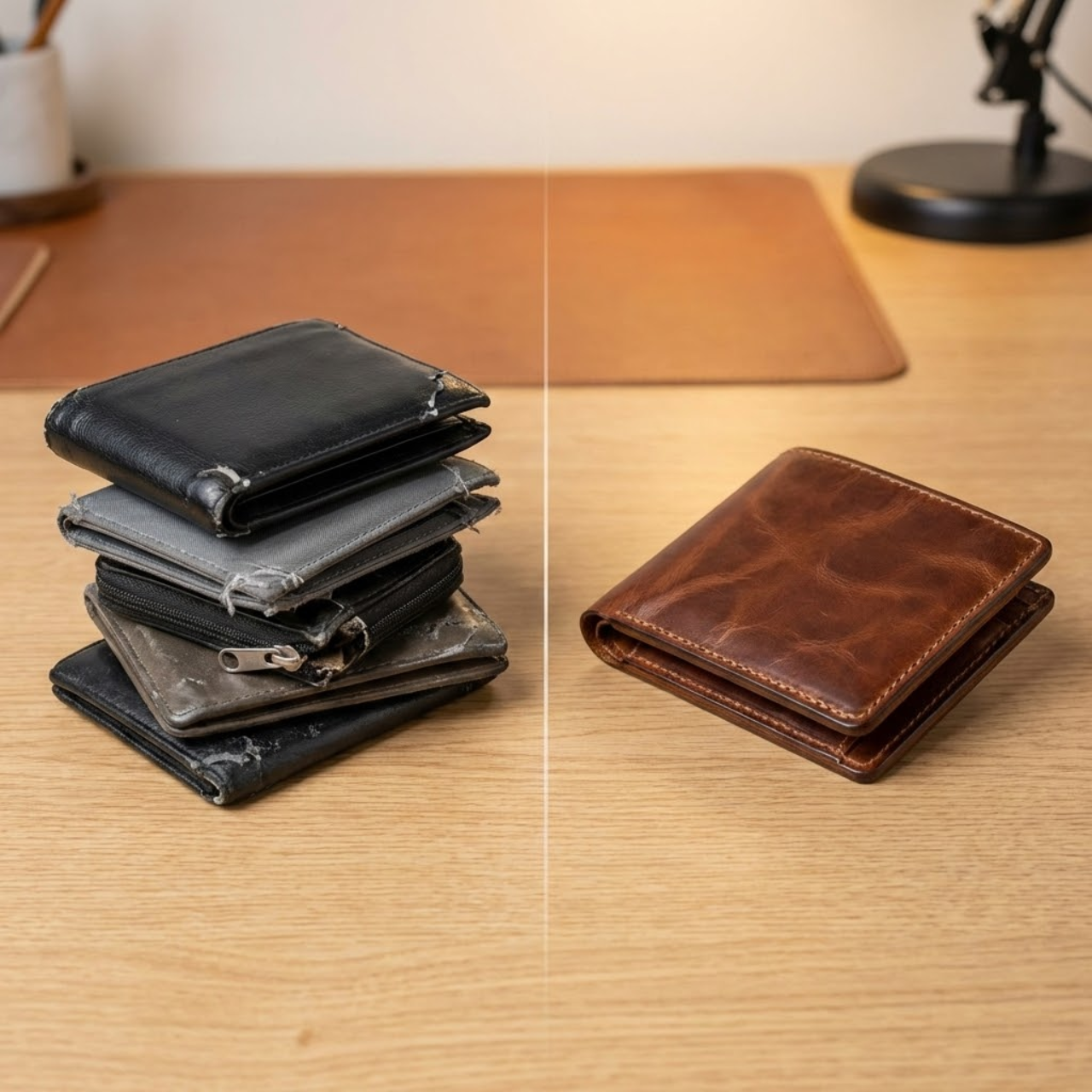
The cheapest wallet costs $15. The most expensive? Maybe $800. Yet the $15 version falls apart in six months, while the $800 piece outlasts a decade. Most people replace the cheap wallet three times in two years, spending $45 and still ending up with a fraying mess. The math seems obvious, but psychology gets in the way.
Loss aversion explains why that $15 purchase feels safer than committing to quality. Behavioral economists Daniel Kahneman and Amos Tversky demonstrated that humans feel losses roughly twice as intensely as equivalent gains. Spending $200 on a bifold wallet triggers immediate pain. Watching a $15 wallet disintegrate six months later? That's just mild disappointment spread across time.
This cognitive bias costs people thousands over a lifetime. It keeps them trapped in a cycle of replacement purchases, each one feeling "affordable" while the cumulative cost dwarfs what a single quality item would have required. The buy once cry once philosophy directly challenges this pattern, demanding upfront investment that feels uncomfortable but delivers lasting value.
The Neuroscience of Immediate Pain vs. Future Regret
Brain imaging studies reveal distinct neural patterns when people anticipate spending money. The insula - a region associated with physical pain - lights up during purchase decisions. The more expensive the item, the stronger the activation. This isn't metaphorical discomfort; the brain processes financial loss using the same circuitry as physical injury.
Quality leather goods trigger this response intensely. A full-grain leather wallet priced at $180 creates measurable neural activity that a $20 synthetic version doesn't. The cheaper option slips past our pain threshold. The brain barely registers it.
The replacement cycle that follows operates differently. Discovering your wallet's stitching has failed doesn't activate the insula the same way. It's frustration, not acute loss. You've already adjusted to the item's absence from your bank account. The new purchase feels like solving a problem, not creating one.
This explains why people repeatedly buy inferior products. Each individual purchase stays below the pain threshold. The pattern becomes invisible because the brain never aggregates these micro-losses into a single, painful sum. The quality investment philosophy requires overriding this automatic response.
What Buy Once Cry Once Actually Means
The phrase originated in tool communities, where tradespeople learned that cheap equipment costs more through replacement, downtime, and inferior results. It spread to outdoor gear, then to everyday carry items. The principle remains consistent: endure the upfront cost once, then enjoy years without replacement expenses.
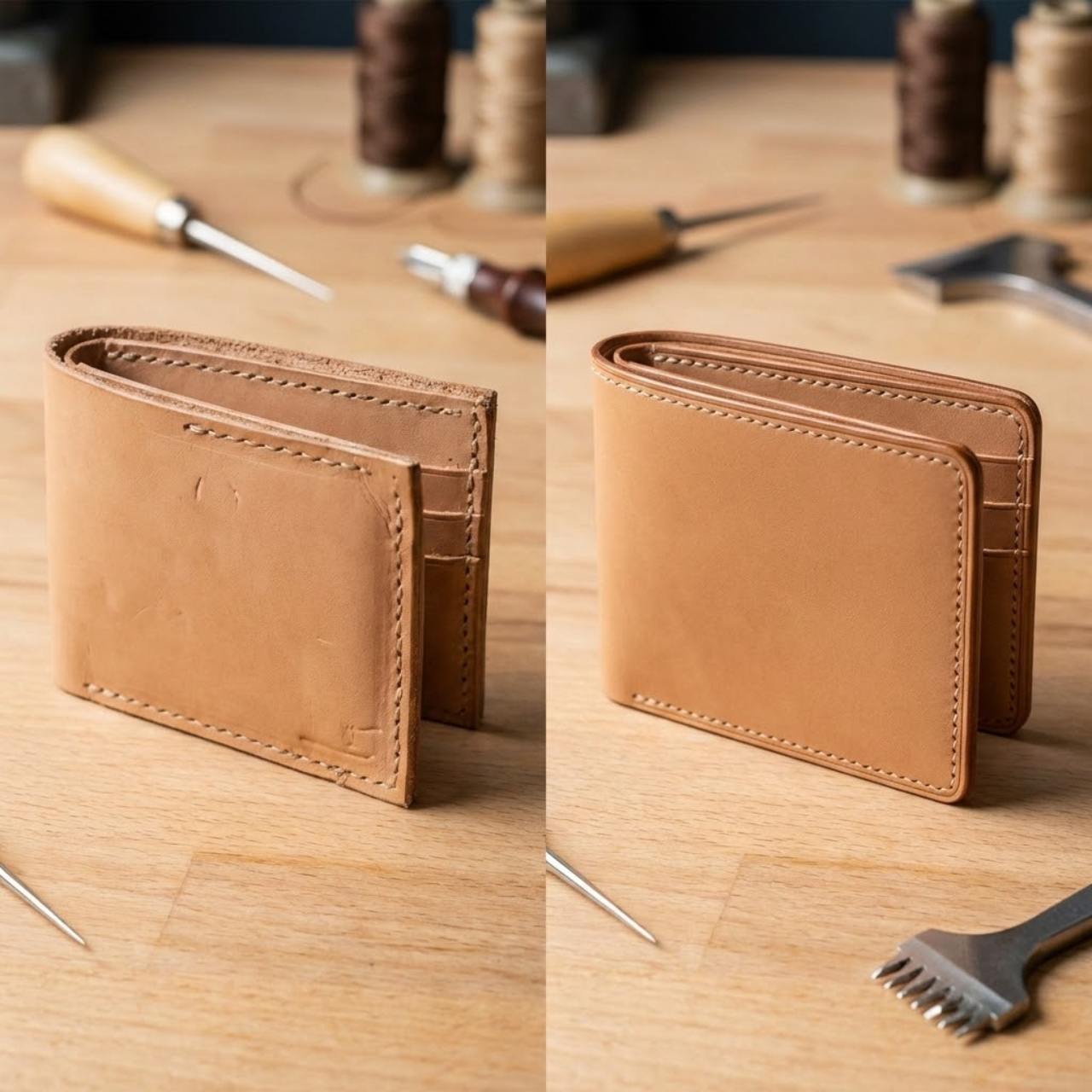
Full-grain leather embodies this philosophy perfectly. Unlike top-grain or genuine leather - industry terms for corrected, sanded surfaces - full-grain retains the hide's complete structure. It's stronger. It develops patina, that rich color variation and soft sheen, rather than deteriorating. A properly constructed leather wallet using saddle-stitch construction won't fail at the seams.
Compare this to bonded leather or synthetic materials. They photograph well. They feel acceptable initially. But they lack structural integrity. Within months, corners crease permanently, surfaces peel, and stitching pulls through weakened material. Each failure point arrives sooner than expected.
The "cry once" part refers to that initial purchase moment. It's not actually crying - it's the psychological resistance to spending $200 when $20 options exist. But that resistance, while feeling protective, actually increases lifetime costs. The buy once cry once mindset recognizes this paradox and chooses differently.
The Hidden Costs of Cheap Leather Goods
A $25 wallet from a fast-fashion retailer uses corrected-grain leather or bonded leather - leather scraps glued together with polyurethane. Manufacturing costs run around $3-4. The markup covers retail overhead, marketing, and profit margins. Quality isn't the priority; moving volume is.
These wallets fail predictably. Stitching failure occurs within 3-6 months as synthetic thread and machine stitching through thin material create weak points. Corner breakdown happens at 6-12 months because thin leather lacks density to resist daily friction. Surface delamination appears at 8-14 months when corrected grain finishes separate from the leather base. Structural collapse arrives at 12-18 months as the wallet loses shape, cards slip out, and the fold becomes loose.
Each failure triggers a replacement purchase. Over ten years, that's 6-8 wallets at $25 each - $150 to $200 total. You've matched the cost of a premium wallet but own nothing of value. The cheap wallets go to landfills. The environmental cost multiplies.
Then there's the inconvenience cost. Replacing a wallet means transferring cards, updating the item in your daily routine, and dealing with the failure at an inconvenient moment. That's worth something, even if it's hard to quantify. The cheap wallet cycle ignores these hidden expenses entirely.
Why Quality Leather Survives Decades
Full-grain vegetable-tanned leather improves with age because of its cellular structure. The hide's grain layer - the dense, tight outer surface - remains intact. This layer evolved over millennia to protect large animals from environmental damage. It's phenomenally durable.
Vegetable tanning uses organic tannins from tree bark. The process takes weeks, allowing tannins to bond thoroughly with collagen fibers in the hide. This creates a stable material that won't degrade from moisture or UV exposure. Chrome tanning, the cheaper, faster method, uses chromium salts and takes days, but the resulting leather is less durable and can't develop patina.
Saddle-stitching provides structural permanence that machine stitching can't match. Each stitch uses two needles and a single thread, creating a lock-stitch pattern. If one stitch breaks, the rest hold. Machine stitching uses two separate threads; when one breaks, the entire seam can unravel.
Lost Dutchman Leather uses these traditional methods because they produce wallets that last 20-30 years with basic care. The leather darkens, develops character, and becomes more supple. It doesn't break down; it improves. This longevity changes the cost equation entirely. A $200 wallet used for 25 years costs $8 per year. The cheap wallet at $25 every 18 months costs $16.67 per year - more than double.
Breaking the Replacement Cycle
Loss aversion keeps people trapped because it operates automatically. You don't consciously think, "I'll accept higher lifetime costs to avoid immediate pain." The decision feels prudent in the moment. Only later does the pattern become visible.
Breaking this cycle requires conscious intervention. Reframe the purchase as investment, not expense. Calculate cost-per-year rather than upfront price. A $180 card holder lasting 20 years costs $9 annually. That's less than one lunch.
Account for replacement frequency. Track how often you've replaced wallets, phone cases, or bags in the past five years. Multiply replacement cost by frequency. Compare that to a single quality purchase. The numbers reveal the hidden cost of "affordable" options.
Factor in inconvenience. Assign a dollar value to the time and frustration of repeated replacements. Even at $20 per replacement event, that adds up quickly over years. Consider resale value too. Quality leather goods retain value. A well-maintained wallet can sell secondhand for 50-60% of original price. Cheap wallets have zero resale value.
Recognize environmental cost. Manufacturing leather goods requires significant resources. Buying one item instead of eight reduces waste dramatically. These reframes don't eliminate the neural pain of spending more upfront. They provide rational counterweight to the emotional response.
The Patina Effect: When Wear Becomes Value
Cheap leather looks best on day one. Every subsequent day shows deterioration. Scratches become scars. Wear becomes damage. The item moves steadily toward worthlessness.
Quality full-grain leather operates inversely. Initial appearance is good but unrefined. The leather is stiff, the color uniform. Over months and years, handling oils from your hands darken high-contact areas. Scratches blend into the surface rather than marring it. The leather softens and conforms to contents.
This is patina - the visible record of use that increases aesthetic and emotional value. A five-year-old wallet tells a story through its coloration. It's unique to the owner. It can't be replicated or purchased new. This inverts the typical depreciation curve. The wallet becomes more valuable to the owner over time, not less. That creates attachment, which further extends the product's life.
Cheap leather can't develop patina because the surface treatment prevents it. Corrected grain leather has been sanded and coated with polymer finishes. These finishes crack and peel rather than aging gracefully. The underlying leather lacks the quality to improve with wear. The buy once cry once approach values this long-term transformation over short-term savings.
When Premium Pricing Reflects Actual Value
Not every expensive wallet justifies its cost. Luxury fashion brands charge $600-800 for items made from corrected-grain leather with machine stitching. You're paying for brand recognition, not material quality or construction superiority. These items don't last significantly longer than mid-range options.
Genuine value pricing reflects material cost - full-grain leather costs 3-5 times more than corrected grain. Vegetable tanning costs more than chrome tanning. These aren't arbitrary markups; they're input costs. Labor intensity matters too. Hand-cutting and saddle-stitching requires skilled craftspeople working slowly. A machine can produce 50 wallets in the time it takes to hand-stitch one.
Failure rate considerations factor in. Quality construction means virtually zero returns for defects. Cheap manufacturing accepts 5-10% failure rates as normal. Design efficiency requires engineering time. A well-designed minimalist wallet uses less material while maintaining function. Company scale affects pricing - small makers can't leverage economies of scale, but this often correlates with better quality control.
The question isn't whether premium leather goods cost more to make - they objectively do. The question is whether that additional cost produces proportional additional value. For items used daily over decades, the answer is yes. Wallets built to last represent genuine value, not just high prices.
The Compound Effect of Quality Across Categories
This principle extends beyond wallets. Apply buy once cry once across everyday carry items, and the lifetime savings become substantial. A quality leather belt costs $120 and lasts 15-20 years. Cheap belts at $25 last 2-3 years. Over 20 years, that's $120 versus $175-200.
Multiply this across wallets, belts, bags, phone cases, keychains, and watch straps. The difference reaches thousands of dollars. More importantly, you spend less time shopping, less time dealing with failures, and less cognitive energy on these decisions. Quality items fade into reliable background elements of life.
There's also a psychological benefit. Owning well-made items that improve with age creates satisfaction that cheap replacements can't match. This isn't materialism; it's the pleasure of using appropriate tools for their intended purpose. The quality investment philosophy delivers both financial and emotional returns.
Making the Switch: Practical Steps
Transitioning from replacement cycles to quality purchases doesn't require replacing everything immediately. That would trigger the same loss aversion that created the problem. Start with one category - the item you replace most frequently.
Calculate your replacement frequency and multiply by cost. Compare that to a quality alternative's cost-per-year over its expected lifespan. Research construction methods. Learn what full-grain leather looks like versus corrected grain. Understand saddle-stitching versus machine stitching.
Buy from makers who explain their materials and methods. Transparency indicates confidence in quality. Companies hiding construction details usually have something to hide. Expect an adjustment period. Quality leather starts stiff. It needs 2-4 weeks to break in. This initial discomfort makes people question their purchase. Push through it.
Maintain the item properly. Full-grain leather needs occasional conditioning - once or twice yearly. This takes five minutes and extends life indefinitely. For specific care recommendations, contact us with questions about your leather type and use patterns.
Conclusion
Loss aversion evolved to protect humans from genuine threats. In modern consumer contexts, it produces the opposite effect - increasing lifetime costs while reducing satisfaction. The $15 wallet feels safe because the loss is small and immediate. The pattern of repeated replacement remains invisible because each purchase stays below our psychological pain threshold.
Buy once cry once isn't about luxury or status. It's about aligning spending with actual value. A $200 wallet that lasts 25 years costs less per year than a $25 wallet replaced every 18 months. The math is straightforward, but psychology makes it difficult.
Quality full-grain leather goods represent one of the clearest applications of this principle. The material improves with age. The construction prevents failure. The result is items that become more valuable to owners over time, not less.
Breaking the replacement cycle requires conscious effort to override automatic responses. Calculate cost-per-year. Factor in replacement frequency and inconvenience. Recognize that the upfront pain of spending more produces years of benefit, while the comfort of spending less produces years of repeated minor costs that compound into major expenses.
The next time a wallet, belt, or bag needs replacement, pause before defaulting to the cheapest option. The immediate savings are real. But so are the long-term costs. One quality purchase ends the cycle. Multiple cheap purchases perpetuate it. The choice between crying once and crying repeatedly becomes clear when you understand the psychology behind it.