Balancing Security and Accessibility: The Quick-Draw Wallet Dilemma
Every time someone reaches for a wallet, they're making a split-second calculation. How fast can they access what they need? How secure is their cash and cards during that moment? The tension between these two needs - quick access and robust security - defines the modern wallet experience.
This balance matters more than most people realize. A wallet that's too secure becomes a frustration during routine transactions. One that's too accessible becomes a liability in crowded spaces. The quick-draw wallet solution has emerged to address this challenge, but understanding how to achieve both goals requires examining what makes each element work.
The challenge isn't just about design - it's about rethinking how leather goods function in daily life. Traditional bifolds prioritized capacity over speed. Minimalist card holders sacrificed organization for slimness. The real question becomes: can a single quick-draw wallet deliver both instant access and genuine protection without compromise?
The Speed Problem with Traditional Wallets
Traditional bifold wallets weren't designed for modern transaction speeds. They emerged in an era when people had time to open, search, and close their wallets without holding up a line. That world no longer exists.
The average bifold requires three distinct actions: opening the fold, locating the correct card or bill, and extracting it from its slot. Each step adds seconds to a transaction. In a coffee shop line or subway turnstile, those seconds accumulate into genuine inconvenience.
Full-grain leather bifolds compound this challenge through their very durability. The thick, premium material that ensures decades of use also creates stiff card slots that grip contents tightly. New leather especially resists quick card removal. This isn't a flaw - it's the natural result of using leather that won't fall apart after a year.
The problem intensifies with organization. Multiple card slots mean more searching. Bill compartments with flaps add extra steps. Coin pockets with snaps or zippers introduce additional barriers. Each organizational feature that improves security or capacity simultaneously slows access.
What Security Actually Means in Wallet Design
Security in wallets extends beyond preventing theft. It encompasses how well a wallet retains contents during normal movement, resists accidental spills, and protects cards from damage or unauthorized scanning.
Physical retention stands as the most basic security measure. Cards shouldn't slide out when a wallet tips sideways in a pocket. Bills shouldn't peek out from gaps in the leather. This requires tight tolerances between slots and contents - the same tightness that slows deliberate access.
RFID protection has become another security consideration. Credit cards and IDs with contactless chips can be scanned without removal from a wallet. Quality leather provides some natural shielding, but dedicated RFID-blocking materials offer more complete protection. This additional layer, however, often adds bulk that affects both pocket comfort and access speed.
Structural security matters too. A wallet's ability to maintain its shape prevents the accordion effect, where everything spills out if opened carelessly. Hand-sewn construction using saddle stitching creates joints that won't fail under stress. Machine stitching might look similar, but it unravels completely if a single thread breaks. The difference becomes critical when leather wallets take daily abuse for years.
Closure mechanisms represent the most visible security feature. Snaps, bands, and flaps all prevent contents from escaping - but they also create barriers to quick access. The wallets that balance this best use the leather's natural friction rather than mechanical closures.
The Minimalist Solution and Its Limitations
Card holders emerged as the answer to slow bifolds. By eliminating folds, flaps, and excess capacity, they promised instant access. Pull a card from an open slot and you're done. The speed advantage is undeniable.
But minimalism creates new problems. Most cardholders accommodate 3-5 cards comfortably. Add more and they bulge, losing their slim profile. This forces users to choose which cards to carry daily - a decision that often proves wrong when the rarely-needed insurance card suddenly becomes essential.
Cash handling in minimalist designs ranges from awkward to impossible. Some card holders include a simple money clip. Others expect users to fold bills and wedge them behind cards. Neither solution provides the organization or security of a dedicated bill compartment. Bills can slip out, fold incorrectly, or get damaged during card removal.
The security trade-off becomes apparent in crowded situations. Open-slot designs that enable quick access also allow cards to slide out more easily during jostling. Some minimalist wallets address this with tighter leather tension, but that reintroduces the access-speed problem they were designed to solve.
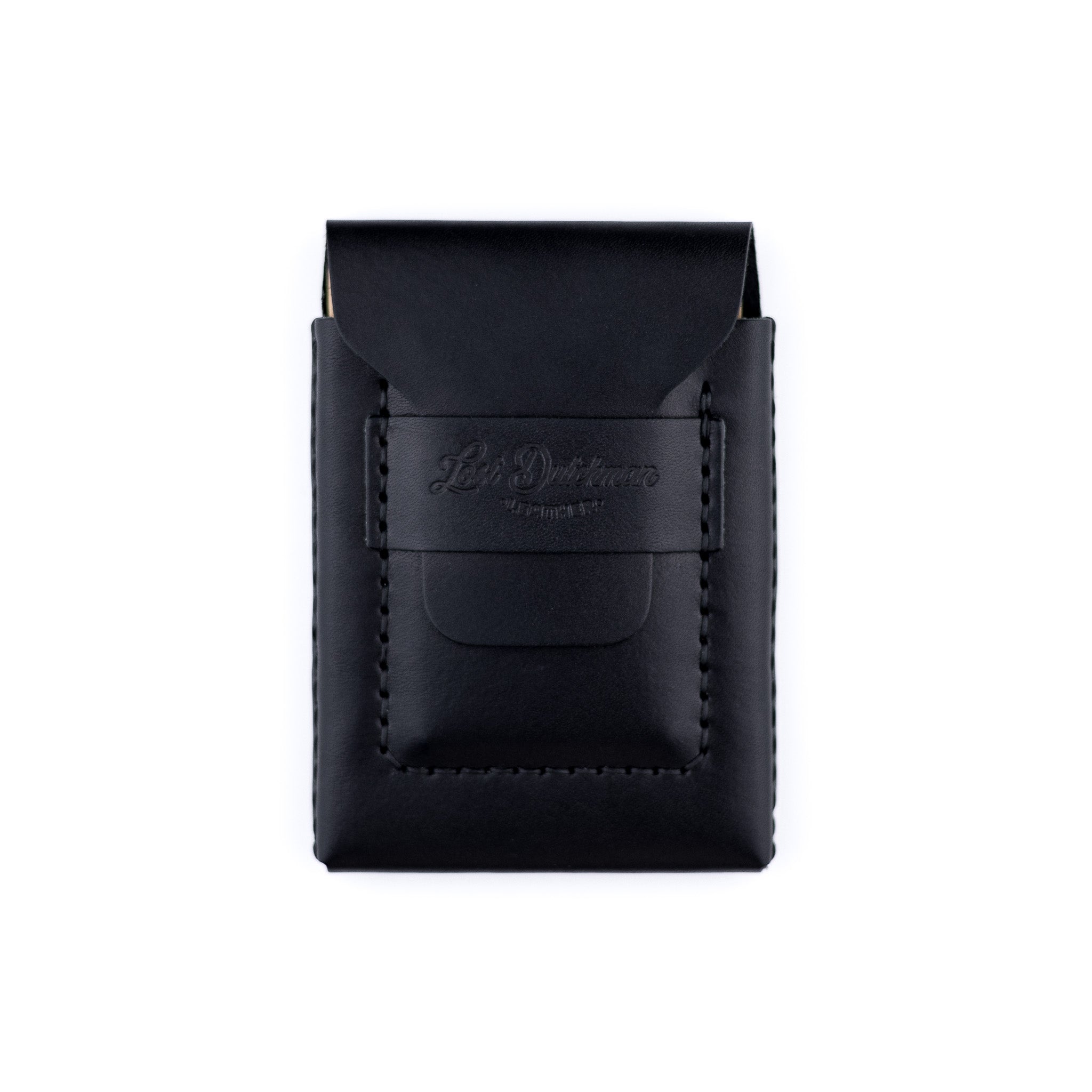
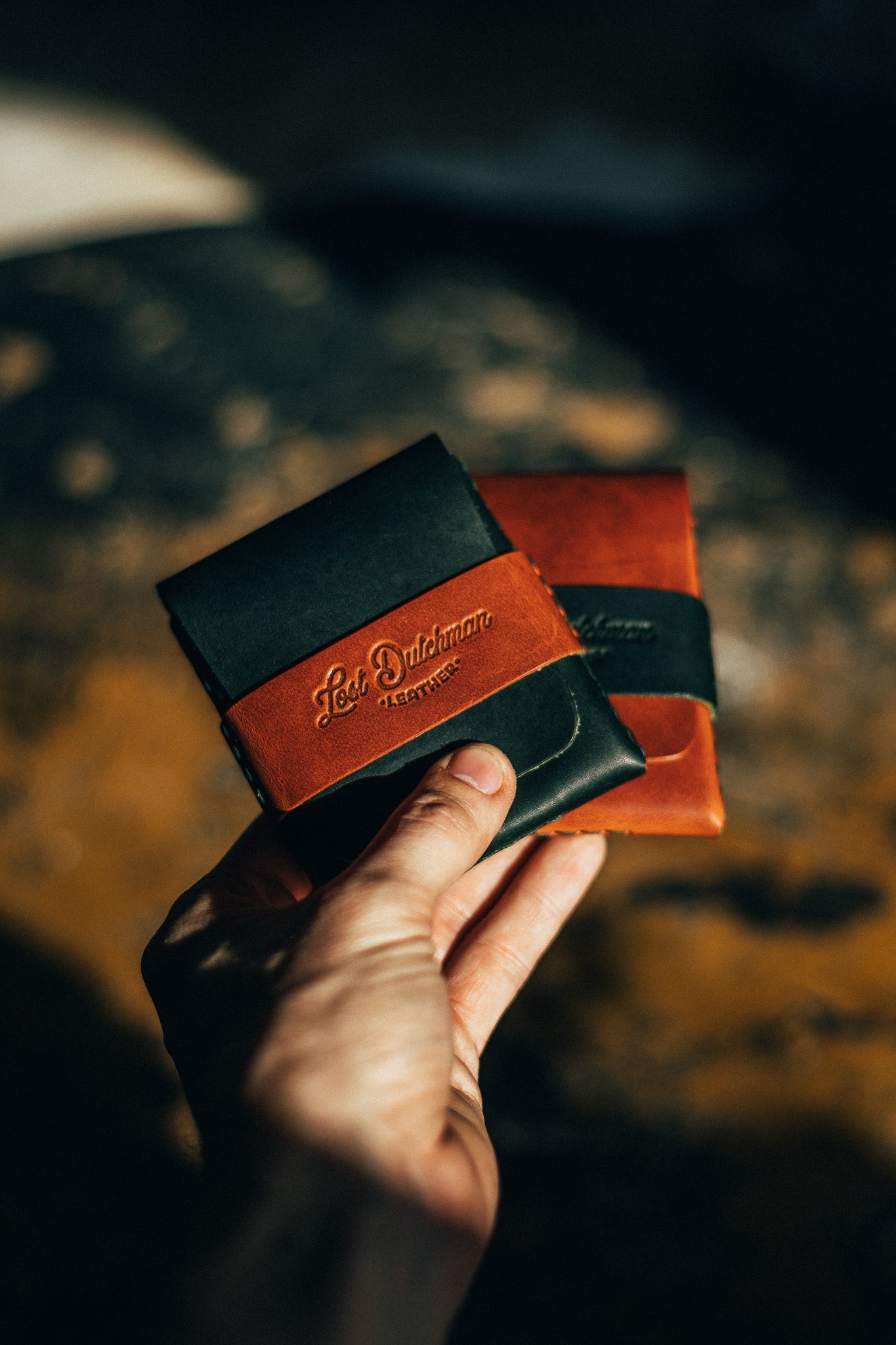
Vertical card holders like The Vertical Dutchman attempt to split this difference. Cards stack vertically with staggered edges for quick identification and removal. The vertical orientation fits front pockets better than traditional bifolds while maintaining better organization than simple card sleeves.
Engineering Quick Access without Sacrificing Security
The solution lies in understanding friction, geometry, and material behavior. Leather's natural properties enable designs that grip contents securely during normal movement but release them easily during deliberate extraction.
Slot geometry determines this balance. A slot cut slightly smaller than a credit card's width will grip it through friction alone. The leather's flexibility allows the card to enter and exit, but ambient movement won't dislodge it. The key measurement typically falls within 0.5-1mm of the card's actual dimensions.
This precision requires full-grain leather specifically. Split leather or bonded leather lacks the structural memory to maintain consistent tension. Top-grain leather with heavy finishing loses the tactile feedback that helps users gauge extraction force. Only full-grain leather provides the combination of grip, flexibility, and durability needed for this engineered friction.
The leather's break-in period actually improves this balance over time. New leather grips tightly - sometimes frustratingly so. But as the material molds to specific cards and develops natural flex points, it begins releasing contents with less force while maintaining secure retention during pocket movement. This aging process can't be rushed without compromising the leather's long-term durability.
Stitch placement affects access speed more than most realize. Stitching too close to card slots restricts the leather's flex, making extraction harder. Stitching too far away allows the slot to deform and lose retention. The optimal distance - typically 3-4mm from the slot edge - allows enough flex for easy access while maintaining structural integrity.
The Single-Piece Advantage
Wallets constructed from a single piece of leather eliminate the weak points that complicate the security-accessibility balance. Without separate panels sewn together, there are fewer opportunities for gaps, misalignments, or structural failures.
The Franklin Wallet exemplifies this approach. Cut and folded from one leather piece, it contains no stitching to fail or create friction points. The design relies entirely on the leather's natural memory and carefully calculated fold geometry to maintain shape and function.
This construction method offers distinct advantages for quick access. Without stitched seams creating rigid boundaries, the leather flexes more naturally during card extraction. Users report that single-piece wallets develop more intuitive access patterns - the leather "learns" their usage and responds accordingly.
Security improves through the elimination of failure points. Traditional wallets fail when stitching breaks or panels separate. Single-piece construction can only fail if the leather itself tears - a rare occurrence with quality full-grain material that typically outlasts the user's need for that particular style.
The Mini Franklin takes this concept further by reducing overall size while maintaining the single-piece advantage. Smaller dimensions mean less pocket bulk and faster location of specific cards within the wallet. The trade-off comes in reduced capacity, but for users who've committed to carrying fewer items, it represents the purest expression of quick-access design.
Material Thickness and Access Dynamics
Leather thickness directly impacts both security and accessibility. Thicker leather (3-4oz) provides superior structural support and durability but requires more force to flex during card access. Thinner leather (2-3oz) allows easier manipulation but may not maintain card retention as reliably over years of use.
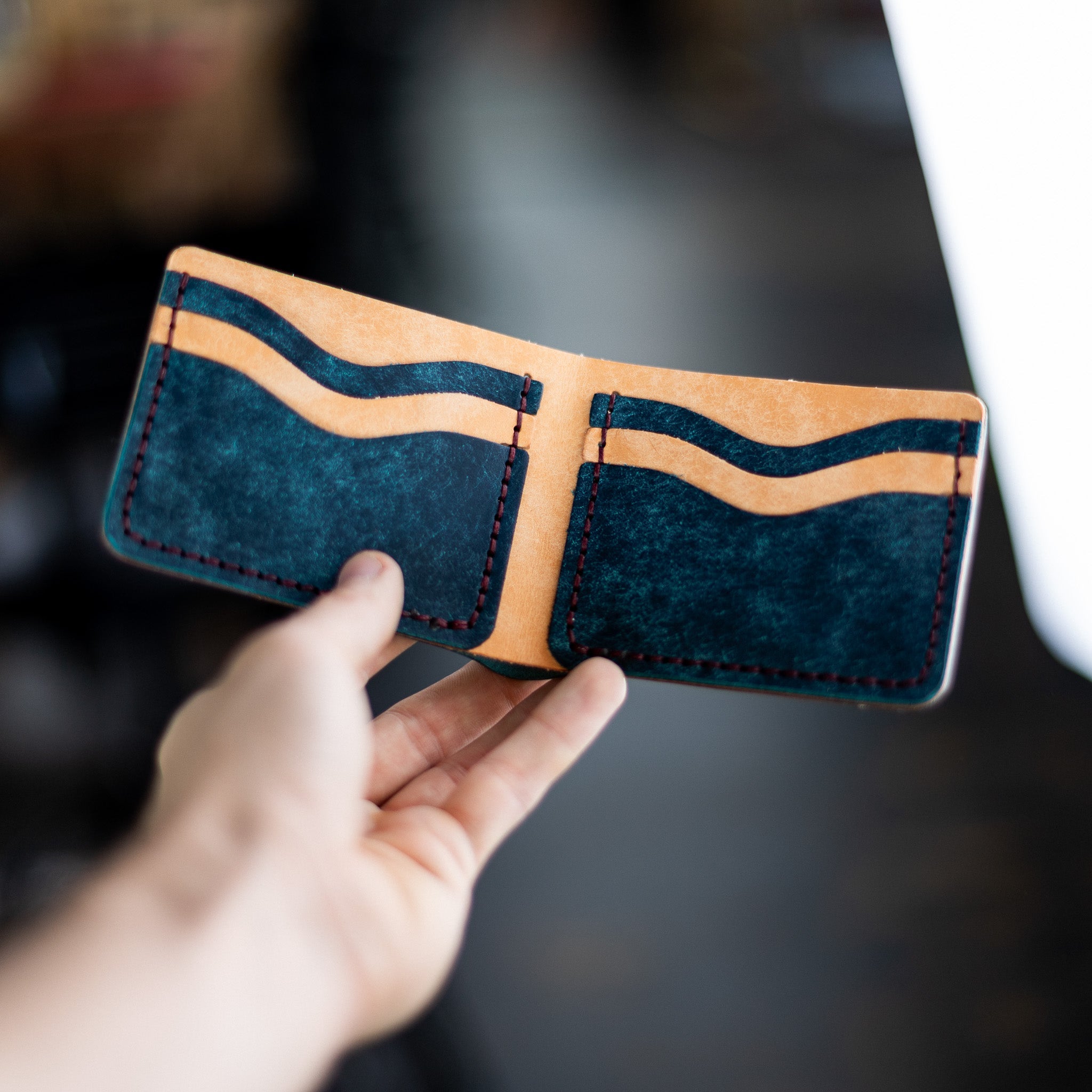
The optimal thickness varies by wallet design and intended use. Bifold wallets benefit from slightly thicker leather (3oz+) because the fold line experiences constant stress. Cardholders can use thinner leather (2-3oz) since they lack fold lines and rely more on slot geometry than material rigidity.
Leather density matters as much as thickness. Dense, tightly-fibered leather resists stretching better than loose-fibered leather of the same thickness. This density prevents card slots from gradually enlarging - a common problem that transforms secure retention into loose, unreliable holding over time.
The leather's temper (its flexibility relative to thickness) determines how easily it responds to access attempts. Well-tempered leather flexes readily under deliberate force but resists gradual deformation from ambient pressure. Poor temper results in leather that either stays too rigid or becomes too soft, both of which compromise the security-accessibility balance.
The Dutchman demonstrates how thickness optimization works in practice. Slightly thicker leather in high-stress areas provides durability, while thinner sections in card-access zones reduce extraction force. This variable-thickness approach requires skilled cutting but delivers measurable improvements in daily use.
Pocket Position and Access Patterns
Where someone carries a wallet fundamentally changes the security-accessibility equation. Front pocket carry prioritizes quick access and theft resistance but demands slimmer profiles. Back pocket carry allows more capacity but introduces sitting-related wear and easier pickpocketing.
Front pocket wallets must balance thinness with usability. Too thin, and the cards slide around inside the pocket alongside the wallet. Too thick and they create uncomfortable bulk during movement. The optimal thickness typically measures 15-20mm when fully loaded - enough structure to maintain shape but slim enough for comfortable carry.
Back pocket wallets can afford slightly more thickness (20-30mm) since they don't press against the leg during standing. However, they face unique security challenges. Rear pockets are easier targets for pickpockets and more prone to accidental loss when sitting. This argues for closure mechanisms like straps or snaps, which reintroduce access delays.
The compromise position - front pocket carry with optimized thickness - has driven much of modern wallet design evolution. Card holders specifically target this use case, sacrificing some capacity and organization for the quick access and security that front pocket carry enables.
Access patterns change based on dominant hand and pocket choice. Right-handed people typically carry wallets in their right front or back pocket for same-hand access. This positioning influences which side of the wallet should open and where card slots should orient for fastest extraction. Ambidextrous designs sacrifice some optimization for universal usability.
The Break-In Period and Long-Term Performance
New leather wallets present their worst security-accessibility balance right out of the box. Stiff leather grips cards almost too tightly. Fold lines resist opening. The material hasn't yet developed the memory patterns that enable intuitive use.
This break-in period typically lasts 2-4 weeks of daily use. During this time, the leather fibers compress in high-contact areas, flex lines develop at fold points, and card slots begin conforming to their contents' exact dimensions. Users who persist through this initial stiffness are rewarded with wallets that perform better each month.
The break-in process can't be artificially accelerated without consequences. Some manufacturers precondition leather to feel softer immediately, but this processing often reduces long-term durability. The stiffness of new full-grain leather signals that the material's fibers remain intact and uncompromised.
Vegetable-tanned leather develops the most dramatic improvement during break-in. The natural tannins continue interacting with oils from handling, gradually softening the leather while maintaining structural integrity. This ongoing transformation means the wallet at one year performs noticeably different - and better - than at one week.
Long-term performance reveals whether a wallet's security-accessibility balance was genuinely engineered or merely accidental. Poorly designed wallets become loose and unreliable after months of use. Well-designed wallets maintain consistent retention force while becoming easier to manipulate through developed flex patterns and user familiarity.
Modern Additions: RFID and Smart Features
Electronic security concerns have introduced new elements to the security-accessibility equation. RFID-blocking materials prevent unauthorized scanning of contactless cards, but they add thickness and can interfere with legitimate card readers if not properly designed.
The most effective RFID protection uses thin metallic fabrics or films integrated into the wallet's structure. These materials block radio frequencies without significantly increasing bulk. However, they do create a Faraday cage effect that requires users to remove cards for contactless payments - reintroducing the access delay that modern wallet design tries to eliminate.
Some wallets incorporate AirTag compatibility for electronic tracking. Leather accessories like the AirTag Keyring demonstrate how leather goods can integrate modern technology, though adding tracking devices to wallets themselves introduces bulk that affects pocket carry and access speed.
The smart feature trend creates a philosophical question: should wallets incorporate technology, or should they remain purely mechanical tools? Technology adds capabilities but also complexity, power requirements, and potential failure points. Traditional leather construction offers reliability through simplicity - no batteries to die, no electronics to malfunction.
For users prioritizing quick access, smart features generally detract from core performance. Every additional component adds thickness, weight, or manipulation steps. The fastest wallet remains the simplest one that precisely matches the user's actual carrying needs.
Choosing Your Balance Point
No universal solution exists for the security-accessibility dilemma. The optimal balance depends on individual carrying habits, card quantities, cash usage, and risk tolerance.
Users who carry 3-4 cards and minimal cash benefit most from minimalist card holders. The reduced bulk and open-slot design enable genuinely instant access. The security trade-off remains acceptable for people who maintain awareness of their surroundings and check their pockets regularly.
Those carrying 6-10 cards plus cash need the organization that only bifolds provide. The slight access delay becomes worthwhile when it prevents the fumbling and searching that disorganized minimalist wallets create when overstuffed.
Front pocket carriers should prioritize slim profiles even if it means slightly slower access. The security and comfort advantages of front carry outweigh the marginal time savings of bulkier designs. Back pocket carriers can afford designs that optimize pure access speed since pocket space isn't as constrained.
Risk assessment matters too. People who frequently navigate crowded transit, travel internationally, or work in high-traffic environments might accept slower access in exchange for closure mechanisms or RFID protection. Those in lower-risk environments can prioritize speed without significant security concerns.
The decision ultimately rests on honest self-evaluation. How many cards do you actually use weekly? How often do you handle cash? Where do you carry your wallet? What situations do you encounter daily? Answering these questions reveals which end of the security-accessibility spectrum serves you best.
Conclusion
The tension between quick access and robust security defines modern wallet design. Traditional bifolds offered organization and protection but sacrificed speed. Minimalist card holders delivered instant access but compromised security and capacity. The best quick-draw wallet solutions engineer specific friction points, optimize material thickness, and eliminate unnecessary complexity.
Full-grain leather remains the ideal material for this balance. Its natural grip, structural memory, and long-term durability enable designs that maintain consistent performance through years of daily use. The break-in period that initially seems like a drawback becomes an advantage as the leather develops personalized flex patterns.
Single-piece construction eliminates failure points while improving access dynamics. Strategic thickness variation optimizes different areas for their specific functions. Thoughtful slot geometry creates the engineered friction that retains contents securely while releasing them easily during deliberate extraction.
The choice between security and accessibility isn't binary. It's a spectrum where each design occupies a specific position based on material selection, construction methods, and geometric precision. Understanding where your needs fall on this spectrum - and choosing a wallet designed for that exact point - transforms the daily experience of accessing cards and cash from a frustration into an intuitive, reliable action.
Quality leather goods from Lost Dutchman Leather demonstrate how traditional craftsmanship addresses modern challenges. By respecting leather's natural properties and engineering designs around them rather than against them, it's possible to create wallets that deliver both instant access and genuine security without compromise. The quick-draw wallet dilemma has a solution - it just requires understanding what makes vegetable-tanned leather work and designing accordingly.
For questions about which wallet design best matches specific carrying needs, contact us for guidance based on real-world usage patterns and material performance.