Thread-to-Leather Ratio: The Mathematics of Strong Stitching
The difference between a wallet that lasts three decades and one that falls apart in three years often comes down to numbers - specifically, the ratio between thread diameter and leather thickness at each stitch hole.
This relationship determines whether stitching reinforces leather or weakens it. Too much thread in too small a hole creates stress concentrations that tear the material. Too little thread in an oversized hole allows movement that abrades both components until failure.
The mathematics isn't an abstract theory. It's the practical difference between a bifold wallet that develops character over time and one that requires premature replacement.
The Core Ratio That Determines Durability
Professional leather workers target a leather stitching ratio between 1:3 and 1:4 for most applications. This means the thread diameter should be roughly one-quarter to one-third the thickness of the leather being sewn.
Calculating Thread Diameter for Common Leather Weights
For a wallet made from 4-5 oz leather (approximately 1.6-2.0mm thick), the ideal thread measures 0.4-0.6mm in diameter. This proportion creates sufficient contact area between the thread and the leather while leaving enough material around each hole to resist tearing.
The ratio shifts based on application stress. Items experiencing constant flexing - like the fold line on traditional bifolds - benefit from ratios closer to 1:3, providing more thread material to distribute forces. Sections under less mechanical stress can use 1:4 ratios without compromising longevity.
Why This Ratio Matters More Than Thread Strength
A common misconception treats thread selection purely as a strength calculation. The logic seems sound: stronger thread equals stronger seam.
The Leather Tear-Out Problem
Reality proves more nuanced. A seam's weakest point typically isn't the thread itself but the leather surrounding each stitch hole. When the thread diameter exceeds optimal proportions, the holes required to accommodate it remove too much material, creating perforation lines that function like tear-away edges on notebook paper.
Consider two scenarios with identical 4 oz leather:
Scenario A: 0.8mm thread requiring 1.2mm holes (ratio of 1:2) Scenario B: 0.5mm thread requiring 0.8mm holes (ratio of 1:3.2)
Scenario A leaves only 0.4mm of leather between the hole edge and the material edge on a standard 3mm stitch line. Scenario B preserves 0.8mm - double the tear resistance despite using "weaker" thread.
Variable Thickness Considerations
The mathematics becomes critical when the leather thickness varies across a single item. The gusset on a card holder might use 3 oz leather while the main panels use 5 oz. Maintaining a proper leather stitching ratio requires different thread sizes or adjusted hole spacing for each section.
Calculating Optimal Stitch Spacing
The thread-to-leather ratio connects directly to stitch spacing through a relationship that balances material removal with seam strength.
The Standard Spacing Formula
The standard formula: Stitch spacing = (Leather thickness × 3) + Thread diameter
For 2mm leather with 0.6mm thread: Minimum spacing = (2mm × 3) + 0.6mm = 6.6mm
This calculation ensures sufficient material remains between holes while maintaining a thread density adequate for load distribution. Spacing stitches closer than this minimum removes too much material, creating structural weakness. Spacing them farther apart reduces the thread contact area, allowing localized stress that accelerates wear.
The "× 3" multiplier derives from empirical testing showing that leather needs approximately three times its thickness in undisturbed material between holes to maintain structural integrity under normal use conditions.
Thread Material Selection and Ratio Adjustment
Different thread materials require ratio adjustments based on their mechanical properties and how they interact with leather over time.
Polyester Thread Characteristics
Polyester thread maintains a consistent diameter under load and resists moisture absorption. Its dimensional stability allows working at the standard 1:3.5 ratio for most applications. The synthetic material's smooth surface also generates less friction during stitching, reducing hole enlargement during construction.
Nylon Thread Properties
Nylon thread exhibits more elasticity and can absorb up to 4% of its weight in moisture, causing diameter fluctuation. This property requires slightly larger initial holes, effectively shifting to a 1:3 ratio to accommodate expansion without creating pressure that splits leather.
Linen Thread Benefits
Linen thread, traditional for hand-stitching, presents unique ratio considerations. It compresses more readily than synthetic alternatives and develops a waxy coating during use that fills micro-gaps. This allows tighter ratios - sometimes approaching 1:4 - without sacrificing long-term performance. The natural fiber also swells slightly when wet, creating a self-sealing effect in the stitch holes.
The Saddle Stitch Advantage in Ratio Management
Hand-sewn saddle stitching creates fundamentally different mechanical relationships than machine stitching, making ratio calculations more forgiving while improving wallet stitching quality.
Machine Stitching Limitations
Machine stitching uses two threads that interlock within the leather thickness, creating a single point of potential failure. If one thread breaks, the entire seam unravels. This vulnerability requires conservative ratios - typically 1:4 or smaller - to minimize stress on the leather around each hole.
Saddle Stitch Mechanical Advantages
Saddle stitching passes a single continuous thread through each hole twice, with each pass coming from opposite sides. This creates a crossing pattern where each stitch independently locks the one before and after it.
The mechanical advantage: saddle stitching can use thread diameters at the upper end of the ratio range (1:3 or even 1:2.5 for high-stress applications) because the crossing pattern distributes forces across four thread segments per hole rather than two. This effectively doubles the contact area between the thread and leather without enlarging holes.
Leather Temper and Ratio Modification
Leather temper - the relative stiffness or flexibility of the tanned hide - significantly impacts optimal thread ratios and overall wallet stitching quality.
Firm Temper Leather
Firm temper leather (like that used in quality belts) contains less residual oil and exhibits more rigidity. This material tolerates smaller ratios because it resists deformation around stitch holes. The thread at 1:4 ratios performs adequately because the surrounding leather maintains its structure under load.
Medium Temperature Applications
Medium temper leather represents the sweet spot for most wallet applications. It balances flexibility for comfortable carry with sufficient structure to support standard 1:3.5 ratios without special considerations.
Soft Temper Adjustments
Soft temper leather requires ratio adjustments toward 1:3 or larger. The increased flexibility means material around stitch holes deforms more readily under stress, concentrating forces on smaller areas. Larger thread diameters distribute these forces across more material, preventing premature hole elongation.
The practical application: a soft-temper card holder might use 0.6mm thread where a firm-temper version of identical thickness could perform adequately with 0.5mm thread.
Edge Distance and the Secondary Ratio
Beyond thread-to-leather ratio, a secondary calculation determines stitch line placement relative to edges - the edge distance ratio.
Edge Distance Formula
The formula: Edge distance ≥ (Leather thickness × 2.5)
For 2mm leather: Minimum edge distance = 2mm × 2.5 = 5mm
This ensures sufficient material exists between the stitch hole and the edge to resist tear-through under load. Placing stitches closer than this minimum creates a failure point where the leather tears away from the stitching rather than the thread breaking or pulling through.
Stress Concentration at Edges
The 2.5 multiplier accounts for the stress concentration that occurs at edges. Material near an edge can only distribute forces in a semicircular pattern rather than the full circular pattern available in the center of a panel. This geometric limitation requires proportionally more material to achieve equivalent strength.
Items experiencing edge-parallel forces - like the card slots on minimalist wallets - benefit from edge distances approaching 3× leather thickness. The additional material prevents the progressive tearing that occurs when cards slide in and out thousands of times over the years of use.
Temperature Effects on Thread-Leather Relationships
Environmental conditions alter the mechanical properties of both thread and leather, effectively changing ratios over time.
Expansion and Contraction Cycles
Leather expands in heat and humidity, and contracts in cold and dry conditions. These dimensional changes occur primarily across the grain rather than through the thickness, but they still affect the stress distribution around stitch holes.
A wallet stitched in a climate-controlled workshop at 20°C and 45% humidity experiences different internal forces when carried in a pocket at 37°C and 80% humidity. The leather expands while the synthetic thread remains dimensionally stable, slightly loosening the thread-to-leather fit within each hole.
Ratio Selection for Environmental Variation
This expansion-contraction cycle explains why proper initial leather stitching ratio matters so much. A thread installed too tightly (ratios below 1:4 in standard applications) can actually cut into expanding leather during hot, humid conditions. A thread installed too loosely (ratios above 1:3) allows excessive movement during cold, dry conditions, leading to abrasive wear.
Quality construction accounts for this by targeting mid-range ratios (1:3.5) that perform adequately across typical environmental variations without reaching failure thresholds at either extreme.
The Burnishing Factor in Ratio Optimization
Edge burnishing - the process of compressing and polishing leather edges - creates a denser material structure that influences optimal stitch placement and thread selection.
Burnished Edge Density Increase
Burnished edges exhibit approximately 15-20% greater density than unburnished leather in the compressed zone, typically extending 0.5-1mm into the material. This densification effectively increases the material's resistance to thread pull-through in the edge region.
The practical impact: stitching near burnished edges can use thread at the higher end of the ratio range (approaching 1:3) without the increased risk normally associated with edge-proximate stitching. The densified material provides the additional tear resistance needed to compensate for the geometric disadvantage of edge placement.
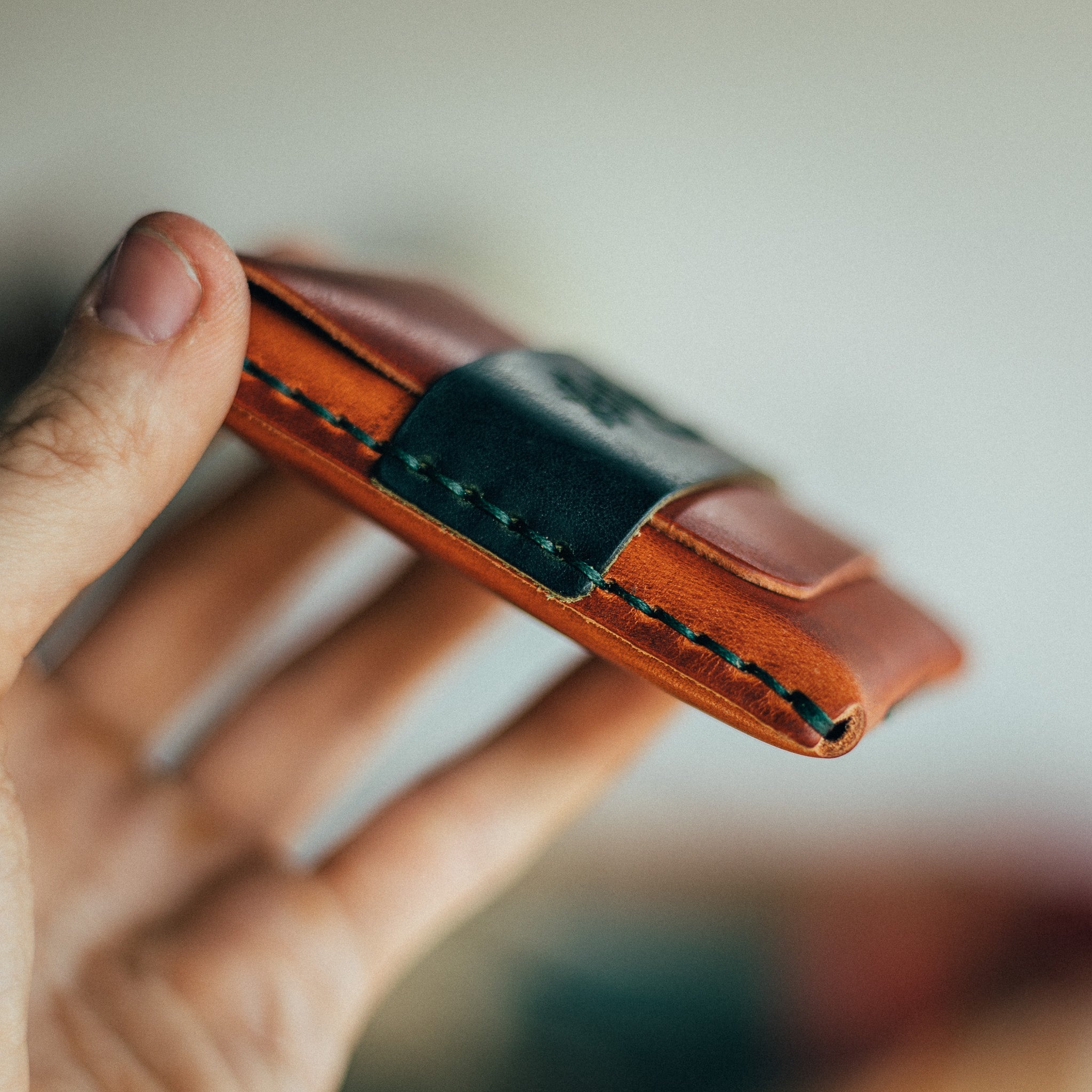
This principle applies particularly to items from Lost Dutchman Leather, where edge stitching creates the characteristic aesthetic while maintaining structural integrity through proper burnishing and ratio management.
Stitch Angle and Its Effect on Effective Ratios
The angle at which the thread enters and exits the leather alters the effective thread-to-leather contact area, modifying the functional ratio even when thread diameter and leather thickness remain constant.
Perpendicular Versus Angled Stitching
Perpendicular stitching (90° to the leather surface) creates circular holes with a contact area equal to πr², where r equals thread radius. This represents the baseline for ratio calculations.
Angled stitching - whether intentional for aesthetic reasons or resulting from hand-stitching variation - creates elliptical holes with greater surface area. A stitch entering at 75° rather than 90° increases hole area by approximately 15%, effectively loosening the ratio by a similar proportion.
Consistency in Hand-Stitching
This geometric reality explains why consistent stitch angle matters beyond aesthetics. Variation in angle creates variation in effective ratios along a seam, producing weak points at the most acute angles where thread-to-leather contact decreases.
Hand-stitching naturally produces some angle variation, typically 5-10° from perpendicular. Experienced makers compensate by targeting ratios slightly tighter than theoretical calculations suggest - using 1:3.3, where 1:3.5 would suffice with perfectly perpendicular machine stitching.
Load Direction and Ratio Requirements
Forces applied to stitched seams arrive from different directions depending on the item's function, requiring ratio adjustments based on anticipated load patterns.
Tension Loads
Tension loads pull directly along the stitch line, attempting to separate the joined pieces. These loads distribute relatively evenly across all stitches and represent the scenario for which standard ratios are calculated.
Shear Loads
Shear loads push parallel to the leather surface, trying to slide one piece past the other. These loads concentrate forces on the thread segments within the leather thickness rather than at the entry/exit points. Shear-dominant applications benefit from ratios toward 1:3, providing more thread material to resist the lateral forces.
Peel Loads
Peel loads attempt to separate leather pieces by lifting one edge away from the other, progressively unzipping the seam. These prove most destructive because they concentrate all force on just a few stitches at the separation point. Items experiencing significant peel loads - like the flap closure on some wallet designs - require ratios approaching 1:2.5 combined with reduced stitch spacing to prevent progressive failure.
Application-Specific Stress Patterns
The card slots on a wallet experience primarily tension loads as cards slide in and out. The fold line experiences combined tension and flex loads during opening and closing. The edge stitching experiences mostly tension with some shear as the wallet flexes during carry. Each location's optimal ratio differs based on these distinct load patterns.
Thread Twist and Its Impact on Effective Diameter
Thread construction - specifically the number and direction of twists - affects its functional diameter within stitch holes, influencing the practical application of ratio calculations.
S-Twist Thread Behavior
S-twist thread (twisted clockwise when viewed end-on) tightens during clockwise hand-stitching motions, slightly reducing its effective diameter as it's pulled through leather. This allows using thread at the higher end of the ratio range because it self-compresses during installation.
Z-Twist Thread Characteristics
Z-twist thread (twisted counter-clockwise) exhibits the opposite behavior, loosening slightly during typical stitching motions. This requires either counter-clockwise stitching or thread selection at the lower end of the ratio range to compensate for the expansion.
Bonded Thread Stability
Bonded thread uses a resin coating to lock the twist structure, preventing diameter changes during stitching regardless of twist direction. This dimensional stability makes bonded thread ideal for applications requiring precise ratio control, though it sacrifices some of the self-sealing properties of unbonded natural fiber threads.
The twist factor becomes particularly relevant in hand-stitching, where the maker controls thread tension and rotation. Machine stitching applies more consistent tension that minimizes twist-related diameter variation.
Practical Ratio Application for Common Wallet Constructions
Translating ratio theory into practice requires understanding how different wallet styles stress their stitching and impact wallet stitching quality.
Minimalist Card Holders
Minimalist card holders use innovative construction that sometimes eliminates stitching entirely, sidestepping ratio concerns through design. Where stitching does appear in slim designs, it typically joins 3-4 oz leather (1.2-1.6mm thick) with 0.35-0.45mm thread at ratios near 1:3.5, prioritizing thinness while maintaining adequate strength for the reduced stress of minimalist carry.
Traditional Bifolds
Traditional bifolds join multiple leather layers of varying thickness, requiring ratio adjustments at different construction points. The main body might use 5 oz leather with 0.6mm thread (1:3.3 ratio) while card slot construction uses 3 oz leather with 0.4mm thread (1:3.75 ratio). This variation maintains consistent performance across the different structural demands within a single item.
Vertical Wallet Formats
Vertical wallets experience different force distributions than horizontal bifolds. The vertical orientation places more stress on horizontal stitch lines as cards push outward against gravity. These seams benefit from ratios approaching 1:3 to handle the increased load.
The Role of Stitch Hole Preparation
How stitch holes are created significantly impacts whether theoretical ratios translate into practical performance.
Awl-Punched Holes
Awl-punched holes (traditional hand-stitching method) create diamond-shaped openings that provide more thread-to-leather contact area than circular holes of equivalent width. The diamond shape also aligns with typical thread cross-sections after tension is applied, creating more intimate contact. This allows slightly looser ratios - approaching 1:4 - without performance penalties.
Round-Punched Holes
Round-punched holes (common in machine stitching) create precise circular openings that match theoretical ratio calculations. Their consistency makes them ideal for production work where uniformity matters, but they provide slightly less contact area than diamond holes of equivalent maximum width.
Drilled Holes
Drilled holes (used in some production methods) can create rough interiors that abrade the thread over time. These require ratios at the conservative end of the range (1:4 or smaller) to ensure sufficient thread diameter to resist the increased wear from rough hole surfaces.
The hole preparation method chosen directly influences the thread selection and spacing decisions that determine long-term durability.
Testing and Validation of Ratio Choices
Theoretical calculations provide starting points, but validation requires physical testing under realistic conditions.
Pull Testing
Pull testing measures the force required to separate stitched pieces, revealing whether thread strength or leather tear-out represents the failure mode. Optimal ratios produce failure at the thread's rated strength rather than premature leather failure, indicating that the ratio successfully distributes forces across adequate material.
Flex Testing
Flex testing repeatedly bends stitched seams through their expected range of motion, simulating years of wallet opening and closing in accelerated timeframes. Proper ratios show minimal hole elongation and no leather cracking adjacent to stitch holes after thousands of cycles.
Environmental Cycling
Environmental cycling exposes stitched samples to temperature and humidity extremes, revealing whether ratios remain adequate as materials expand and contract. Successful ratios maintain performance across the full environmental range without thread loosening or leather compression.
These validation methods confirm that mathematical ratios translate into real-world durability before construction begins on items intended for decades of daily use.
Conclusion
The mathematics of thread-to-leather ratios transforms abstract numbers into tangible durability. A leather stitching ratio of 1:3.5 isn't arbitrary - it represents the precise balance where thread provides maximum reinforcement while leather retains sufficient structure to resist tearing.
This relationship explains why some wallets develop distinguished patina over decades while others fail within years despite appearing similar when new. The difference lies in the millimeter-scale decisions about thread diameter, hole spacing, and edge distance that proper ratio calculations inform.
Understanding these principles reveals that quality leather goods construction isn't about using the strongest possible thread or the thickest available leather. It's about achieving mathematical harmony between components, where each element supports the others in proportion calculated to distribute forces, accommodate environmental changes, and resist the specific stress patterns each item experiences during its intended use.
The next time a hand-stitched wallet crosses your hands, those neat rows of stitching represent more than craftsmanship - they embody applied mathematics that turns premium materials into heirloom-quality goods. For questions about how these principles apply to specific construction methods and wallet stitching quality, contact us to discuss the technical details behind lasting quality.