Skydiving and Skydiver: Securing Your Wallet at 15,000 Feet
Exit altitude reaches 15,000 feet. The door opens. Wind roars at 120 miles per hour during freefall. In these extreme conditions, a skydiving secure wallet 15000 feet above ground faces forces that would destroy ordinary accessories within seconds. Skydivers who've watched phones, sunglasses, or loosely secured items rip away during exit understand this reality - at altitude, everything must be purpose-built or properly secured.
The intersection of adventure sports and everyday carry presents unique challenges. While most people never question whether their wallet will stay in their pocket, skydivers cannot afford such assumptions. Between harness pressure, wind force, and the physical dynamics of freefall, personal items require deliberate planning and robust construction to survive intact.
The Physics of Freefall and Your Personal Items
Terminal Velocity and Equipment Stress
During freefall, a human body reaches terminal velocity around 120 mph in belly-down position. At these speeds, wind force against exposed surfaces generates tremendous pressure. Any item not fully enclosed within a secure pocket experiences forces attempting to tear it free. A wallet partially protruding from a pocket acts like a sail, catching air and creating leverage against whatever holds it in place.
The physics become more severe during dynamic maneuvers. Tracking, barrel rolls, and formation flying create additional stresses. Items that seemed secure in stable freefall can shift during these movements. This explains why experienced skydivers emphasize complete enclosure within zippered or snapped pockets rather than relying on friction alone.
Extreme altitude gear must account for these forces from the design phase. Standard pockets with open tops fail immediately. Even button closures prove insufficient if the button faces pressure that can pop it open. The solution requires closure mechanisms designed to resist outward force - quality zippers, secure snaps, or redundant securing systems.
Real-World Examples of Lost Items
Drop zones maintain collections of lost items found in landing areas and aircraft - phones, cameras, wallets, keys, and jewelry that escaped during jumps. Some skydivers discover losses only after landing, realizing their pockets emptied during freefall. Others watch items disappear during exit or deployment, seeing them tumble away beyond recovery.
The financial impact varies. A lost phone represents replacement cost plus data recovery challenges. A lost wallet means canceled cards, replaced licenses, and potential identity theft if found by someone else. Keys require lock changes or costly replacements. These scenarios share a common cause - inadequate securing of items before exit.
Prevention strategies developed through decades of jumping experience provide reliable solutions. Purpose-built jumpsuits feature secure pockets with redundant closures. Skydivers learn to verify every zipper and snap before boarding. Items that cannot be absolutely secured stay on the ground. These practices, combined with appropriate extreme altitude gear selection, virtually eliminate lost item incidents.
What Makes a Wallet Skydiving-Safe
Compact Profile Requirements
Jumpsuit pockets have limited depth and width, designed to minimize bulk against the body while maintaining streamlined profiles. A wallet measuring more than 0.4 inches thick creates uncomfortable pressure points under harness straps. This bulk also prevents proper pocket closure, leaving gaps where wind can penetrate and create lift.
The ideal skydiving secure wallet 15000 feet configuration prioritizes thinness and flexibility. Leather naturally compresses under pressure while maintaining structural integrity. A well-broken-in minimalist wallet conforms to pocket contours, reducing profile while keeping contents secure. This design philosophy eliminates unnecessary features - no bulky coin pouches, no thick fold-over flaps, just essential card capacity and minimal cash space.
Weight distribution also matters. A heavy wallet loaded with coins or excess cards creates uneven pressure that can shift during freefall. Skydivers who jump regularly trim contents to absolute essentials - one ID, one credit card, emergency cash. This minimalism serves safety and comfort simultaneously.
Secure Closure Mechanisms
The closure mechanism represents the critical failure point for any extreme altitude gear. Open-top designs fail immediately. Simple fold-over styles without securing features rely entirely on friction - inadequate against wind force. The closure must actively resist opening forces while remaining easily accessible on the ground.
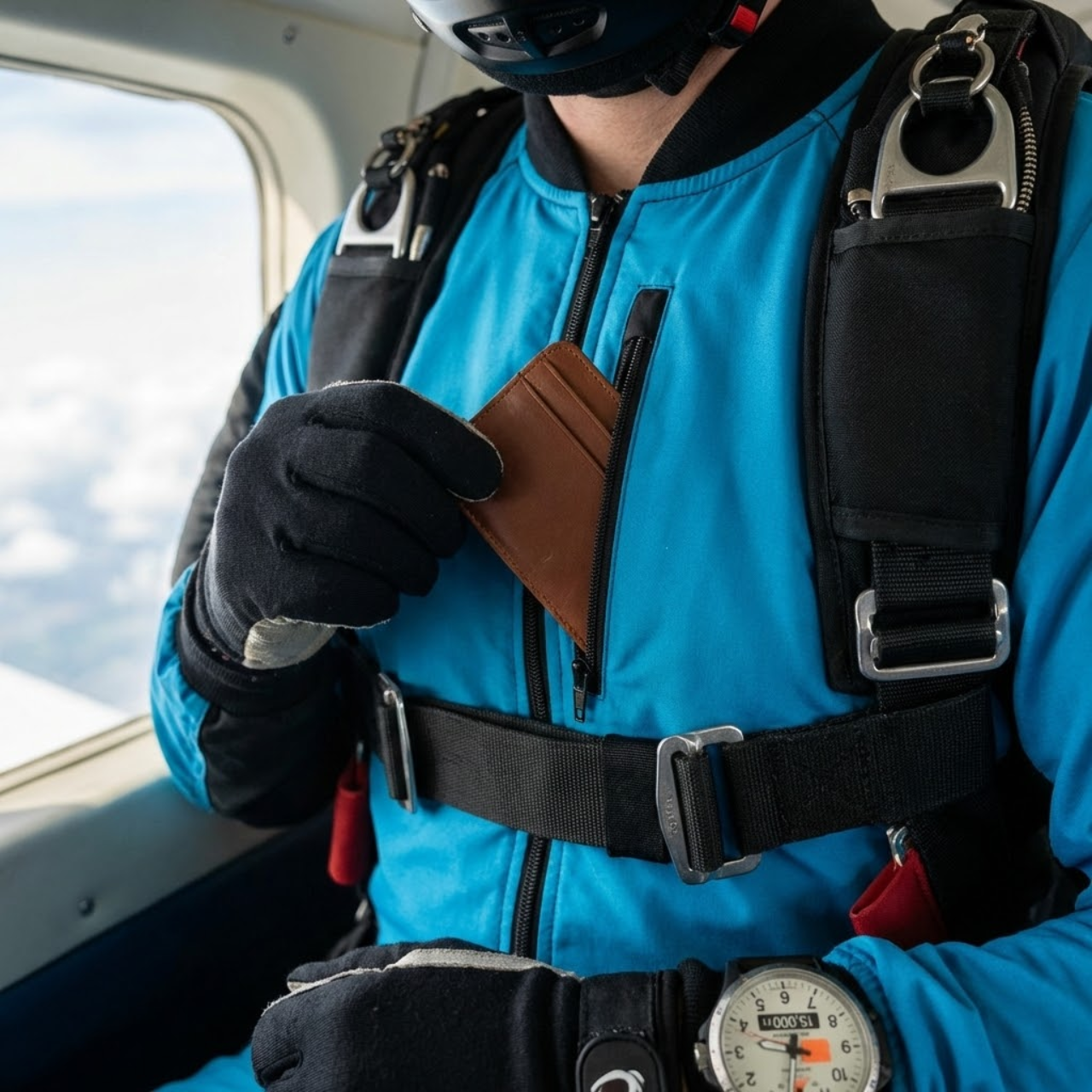
Quality snaps provide excellent security when properly installed. The snap must require deliberate pressure to open, not just light pulling. Button closures can work but require large, secure buttonholes that won't tear or stretch. Many skydivers prefer wallets without external closures at all - card holders that rely on pocket security rather than integrated mechanisms.
Testing closure strength before first use prevents failures. Pull firmly on the wallet as if wind were attempting to open it. If the closure shows any weakness or if you can peel it open with light force, it will fail during freefall. Reliable closures require significant deliberate force to open - anything less represents a liability at altitude.
Material Durability at Extreme Altitude
Temperature variations during a single jump span 40+ degrees. Aircraft cabins at 15,000 feet may reach -20°F. Landing areas on summer days exceed 90°F. This thermal cycling stresses materials, causing some to crack, others to soften excessively. Synthetic materials particularly struggle with cold, becoming brittle and prone to catastrophic failure.
Full-grain leather maintains flexibility across this temperature range. The natural fibers expand and contract without structural damage. Lost Dutchman Leather products use vegetable tanned leather that performs reliably in extreme cold without the brittleness characteristic of some chrome-tanned alternatives. This temperature stability proves especially valuable for skydivers who jump year-round in varying climates.
Moisture resistance also impacts durability. Passing through clouds introduces condensation. Sweat during hot summer jumps adds moisture from inside. Leather's natural breathability manages these moisture challenges while maintaining structural integrity. The material absorbs limited moisture without losing shape, then releases it through natural evaporation.
Choosing the Right Wallet Design for Skydivers
Minimalist Card Holders
The most secure approach to skydiving secure wallet 15000 feet above ground eliminates bulk entirely. A minimalist card holder carries 3-5 essential cards in a profile measuring barely 3 inches by 2 inches. This compact size fits completely within even small jumpsuit pockets, ensuring no portion protrudes to catch wind.
Card holder designs excel for skydivers because they eliminate moving parts and complex closures. Cards stack flat within leather sleeves, secured by friction and pocket enclosure rather than additional mechanisms. This simplicity reduces failure points while maintaining complete functionality for essential carry.
RFID protection provides additional value for traveling skydivers. Drop zones attract international jumpers carrying multiple credit and debit cards. RFID-blocking construction in compact card holder designs prevents electronic pickpocketing while adding negligible thickness.
Bifold vs Trifold Considerations
For skydivers who require more capacity than card holders provide, bifold wallets offer the best compromise between space and security. The bifold design folds once, creating a package roughly 3.5 by 4 inches - still manageable for jumpsuit pockets. This configuration accommodates more cards plus folded cash without the thickness that triple-folding introduces.
Trifold wallets generally prove too thick for skydiving applications. The triple fold creates bulk exceeding most pocket depths, preventing secure closure. Some skydivers report trifolds shifting during freefall even in zippered pockets, as the thickness prevents proper compression. The bifold's simpler fold pattern creates more predictable dimensions that pockets can fully contain.
Chain and Tether Options
Wallet chains present mixed benefits for skydivers. On one hand, a chain provides ultimate security - the wallet physically cannot separate from the person. On the other hand, any protruding chain or attachment point creates a snag hazard during exit or deployment. Skydivers must carefully evaluate their specific setup and jump style before adding chains.
For those who choose chains, the attachment point matters significantly. Chains should connect to secure harness points rather than jumpsuit loops that could tear free. The chain length must prevent the wallet from reaching exits or deployment handles where it might interfere with emergency procedures. Many experienced jumpers skip chains entirely, trusting proper pocket security over additional tethering.
Extreme Altitude Gear Beyond Wallets
Key Management Systems
Keys present similar security challenges as wallets but with added snag risks. Traditional key rings with multiple keys create bulk and protrusions that catch on equipment. Compact key organizers consolidate keys into flat profiles, reducing these hazards while maintaining security.
Carabiner-compatible key holders allow attachment to dedicated harness points or jumpsuit loops designed for this purpose. The key holder must feature smooth surfaces without sharp edges that could damage equipment or cause injury. Some skydivers prefer leather key organizers that fold keys together in compact packages, eliminating all protrusions.
Many drop zones provide lockers for items that don't need to go aloft. Keys that open storage units or vehicles can stay on the ground with ground crew or in personal lockers. This eliminates risk entirely while ensuring access after landing. The decision to carry keys during jumps should be based on necessity rather than convenience.
Leather Belt Considerations
Standard belts typically stay on the ground during skydiving. Jumpsuits and harness systems don't accommodate traditional belt use. However, some skydivers who jump in street clothes rather than dedicated jumpsuits need leather belts that won't interfere with harness fitting.
The belt must feature a low-profile buckle that doesn't create pressure points under leg straps. Smooth leather without decorative elements prevents snags. Quick-release buckles sometimes prove valuable for rapid harness adjustments, though traditional buckles work fine if the belt stays loose enough for easy harness integration.
Weight belts used by lighter jumpers to improve fall rate present different requirements. These thick, heavy belts typically use Velcro or specialized buckles designed for quick release during emergencies. While usually separate from everyday belts, weight belt selection impacts overall gear loadout and must be considered in the complete system.
Protective Cases and Organizers
Skydivers who film jumps face additional extreme altitude gear challenges. Cameras and phones require protective cases that survive freefall forces while allowing operation during flight. Leather cases provide excellent protection but must feature extremely secure closures - typically zippers with locks or multiple snaps.
Document preservation during international travel requires waterproof, impact-resistant storage. A leather passport cover offers protection during normal travel but shouldn't go aloft unless absolutely necessary. Most skydivers leave non-essential documents in locked vehicles or drop zone storage.
Pre-Jump Security Checklist
Pocket Inspection Protocol
Before every jump, systematic pocket inspection prevents lost items. Starting from the bottom up, verify each pocket's contents and closure:
-
Leg pockets - empty or verify zipper/snap fully closed
-
Hip pockets - confirm wallet secure, closure verified
-
Chest pockets - check camera/phone case integrity
-
Arm pockets - verify closure mechanisms
This inspection should become automatic ritual, performed while gearing up and again before boarding the aircraft. Other jumpers in the load provide additional verification, often catching open pockets or loose items that the jumper missed.
Weight and Balance Considerations
Uneven loading of pockets affects body position during freefall. A heavy wallet in one pocket without counterbalance on the opposite side creates subtle asymmetry that skilled skydivers notice and correct but that beginners might struggle with. The ideal solution distributes weight symmetrically or keeps all weight centered on the body.
Most skydiving secure wallet 15000 feet applications involve minimal weight - a few cards and bills add negligible mass. However, combined with keys, phones, and other items, the total weight requires attention. Instructors may ask students to remove items if weight distribution seems problematic or if the student struggles with body position.
Drop Zone Best Practices
Every drop zone establishes protocols for securing personal items. Some provide lockers for all jumpers. Others offer lockboxes or secure areas where items can be left with ground crew. Following these protocols eliminates the need to carry non-essential items during jumps.
Ground crew members, often experienced jumpers themselves, understand securing requirements and can advise on proper procedures. They've seen every failure mode and can spot potential problems before jumpers board aircraft. Utilizing their experience and asking questions about specific items prevents problems.
Material Science: Why Leather Excels at Altitude
Temperature Performance
The temperature variations experienced during altitude changes stress most materials. Synthetic wallets using vinyl or bonded leather become rigid in cold, making them difficult to access and prone to cracking. PU leather particularly struggles with temperature cycling, developing surface cracks that worsen over time.
Full-grain vegetable tanned leather maintains consistent flexibility across the temperature range. The natural fiber structure flexes rather than fracturing when cold. This reliability means a skydiving secure wallet 15000 feet above ground functions identically to the same wallet at ground level - no stiffness, no difficulty accessing cards, no weather-dependent failures.
Long-term cold exposure does eventually affect leather, but the timescale spans hours rather than minutes. The brief exposure during skydiving operations (15-20 minutes from takeoff to landing) causes no meaningful change in leather performance. This stands in stark contrast to many synthetic materials that react poorly to even brief cold exposure.
Moisture Management
Condensation forms when passing through clouds or when temperature differentials cause atmospheric moisture to condense on surfaces. Synthetic materials trap this moisture against contents, potentially damaging cards or cash. Leather absorbs limited moisture while allowing continued air circulation through the material.
After landing, leather releases absorbed moisture through natural evaporation. Setting a damp wallet in the sun or leaving it in normal air allows complete drying without special treatment. This simple maintenance requirement suits the rushed environment of active drop zones where jumpers quickly prepare for the next load.
Sweat during hot summer operations adds moisture from inside. Pockets pressed against the body under harness straps create warm environments where moisture accumulates. Leather's breathability manages this moisture while synthetic alternatives trap heat and humidity, creating uncomfortable conditions that may damage contents over time.
Longevity Under Stress
Repeated compression cycles from harness straps test wallet durability. Each jump applies significant pressure as straps tighten during freefall. Landing impact adds sudden compression forces. Over hundreds or thousands of jumps, these cycles stress construction quality and material strength.
Quality leather goods handle this stress without structural failure. Hand-stitched seams with heavy thread resist the forces that separate cheaper construction. Solid brass or stainless hardware maintains integrity where plated alternatives corrode or break. The investment in proper construction pays dividends in reliability across years of active jumping.
Maintenance for Adventure Leather Goods
Post-Jump Care
After landing, removing dust and debris prevents abrasion during storage. A soft brush or dry cloth wipes away dirt accumulated during ground operations. For items exposed to significant dust or sand, slightly dampening the cloth helps capture particles without spreading them across the leather surface.
Moisture removal matters most after jumps through clouds or on humid days. Opening the wallet and allowing it to air completely before storing prevents mildew growth. This takes mere minutes but prevents problems that would require intensive cleaning later. Setting extreme altitude gear in direct sunlight accelerates drying while providing natural UV disinfection.
Inspecting for damage after each jumping day catches problems early. Check stitching for loose threads, examine hardware for corrosion or looseness, and verify closure mechanisms maintain proper tension. Addressing minor issues immediately prevents field failures during future jumps.
Conditioning Schedule
Active skydivers should condition leather goods every 30-50 jumps or quarterly, whichever comes first. This schedule maintains suppleness despite repeated compression and exposure to temperature extremes. Quality leather conditioner applied with a soft cloth penetrates the surface, restoring natural oils and preventing drying.
Avoid over-conditioning, which makes leather greasy and can cause dye transfer to clothing. A light application worked into the surface provides sufficient protection. Focus conditioning on high-stress areas - fold points, attachment points, and areas that contact harness hardware.
For skydivers jumping in particularly harsh environments (desert heat, extreme cold, high humidity), increasing conditioning frequency to every 20-30 jumps provides additional protection. The extra maintenance preserves flexibility and prevents premature aging from environmental stresses.
Storage Between Jumps
Proper storage extends extreme altitude gear lifespan. Store leather items in cool, dry locations away from direct sunlight when not in use. Avoid leaving wallets compressed in bags for extended periods - allow them to rest flat or loosely stored to prevent permanent creasing.
Climate-controlled storage proves ideal but isn't essential. Simply avoiding extreme conditions (120°F+ heat, below-freezing cold, high humidity) suffices for most situations. For items stored long-term between jumping seasons, placing a cloth bag around leather goods protects against dust while allowing air circulation.
Gear bag organization prevents damage during transport. Dedicated compartments for leather goods keep them separate from hard items like helmets, cameras, and tools that could scratch or compress them. Some skydivers use leather pouches to protect wallets within larger gear bags, adding a layer of organization while preventing damage.
Jump Confidently with Secure Leather Essentials
Skydiving demands absolute reliability from every piece of equipment. While main canopies and reserve systems receive primary attention, personal items require equal consideration. A skydiving secure wallet 15000 feet above ground must withstand forces that would destroy ordinary accessories, maintain functionality across extreme temperature ranges, and resist moisture that damages contents.
Quality leather construction provides the durability, flexibility, and longevity that skydiving applications demand. From minimalist card holders that disappear into jumpsuit pockets to robust bifolds that organize essentials without bulk, purpose-appropriate designs enhance safety while providing the organization modern skydivers expect. The key lies in selecting proven designs built to withstand stresses far exceeding normal use.
For skydivers ready to upgrade their extreme altitude gear with accessories that won't fail at critical moments, exploring handcrafted leather options designed for demanding conditions represents a logical progression. Whether preparing for your first jump or your thousandth, contact us to discuss which wallet designs best suit your jumping style, pocket configurations, and organizational needs. Every jump deserves gear you can trust absolutely, and that confidence starts with choosing accessories built to exceed the extreme conditions they'll face.