
From Sketch to Stitch: The Journey of a New Product Design
Every leather piece begins with an idea, not a spark of corporate innovation, but a hands-on, workshop-born moment of clarity. Sometimes it comes while cutting hide for a new wallet; other times, during a quiet evening in the studio, staring at a design that doesn’t quite feel finished. The goal is always the same: to create something worthy of being carried, used, and eventually worn into a legacy.
At Lost Dutchman Leather, that’s how every new design takes form. The process isn’t hurried, and it’s never mass-produced. Each stage in the leather product design process, from the first sketch to the last stitch, is shaped by experience, trial, and care.
The Spark: Identifying a Need
A good design begins with a problem worth solving. It might come from a conversation with a customer or from frustration with something that doesn’t live up to daily use. The idea for The Franklin Wallet was born from such a moment. Tired of bulky wallets that wore out too soon, the goal became clear: create a piece that was minimalist, durable, and different.
Every workshop project starts this way, with a simple observation. A customer is struggling with a fraying belt. Someone is asking for a slimmer card holder. Or a craftsman wondering how to eliminate a weak seam that never sat quite right.
It’s not just design; it’s problem-solving in its purest form.
Key Takeaways:
-
Every enduring product starts by answering a real need.
-
Listening to feedback shapes stronger designs.
-
The best ideas challenge convention and refine tradition.
Sketching and Conceptualisation
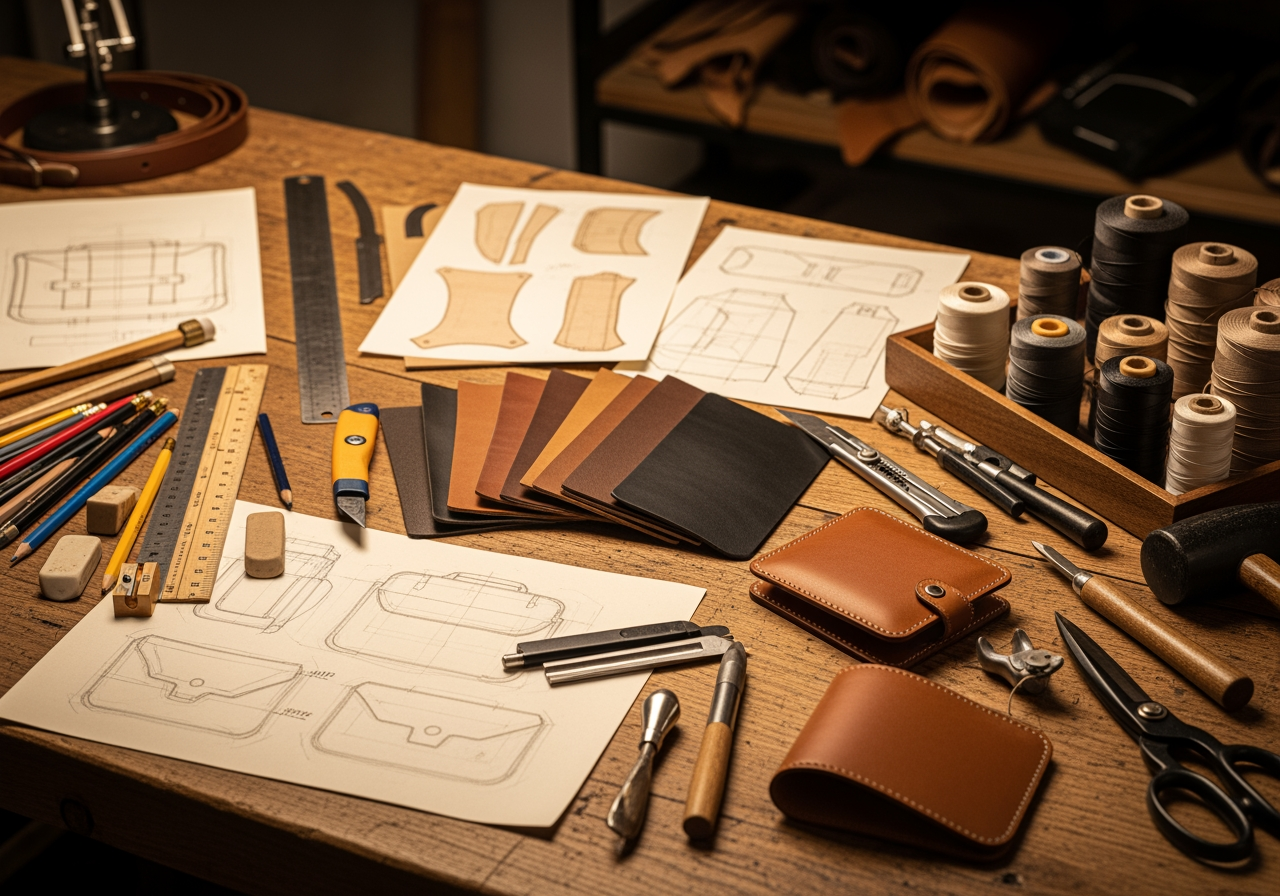
Once the need is clear, it’s time to capture it on paper. Sketching is where imagination meets geometry. Rough outlines give way to clearer forms, each line representing a decision about proportions, stitch placement, or leather thickness.
The leather product design process always begins here, not in software or spreadsheets, but with pencil and paper, ruler and mind. Dozens of concepts take shape before a single one earns the right to move forward.
These sketches map out function and feeling alike. A wallet, for example, must balance slimness with practicality. A belt must feel solid without stiffness. A card holder should open naturally with the flick of a thumb.
It’s not an assembly line, it’s an evolving dialogue between designer, material, and purpose.
Analogy: Designing without sketches would be like building a cabin without a blueprint. You might know the dream, but you’d never quite find the form.
Key Takeaways:
-
Sketching transforms raw ideas into structured plans.
-
Exploration breeds innovation; most designs begin as many and end as one.
-
Every line matters, function dictates form.
Prototyping: Bringing the Idea to Life
No design truly lives until it’s held in the hand. The product prototyping process marks that transition, from vision to touch, from paper to reality.
In the workshop, this means tracing patterns onto scrap leather, cutting by hand, and testing every angle and fold. The first prototype is often imperfect: edges unfinished, seams uneven, proportions slightly off. That’s the point.
A prototype is a question made tangible. Does the wallet sit comfortably in a pocket? Does the belt curve naturally around the waist? Does the snap on the AirTag Keyring fasten securely but release with ease?
Answering those questions takes experimentation. Different thread weights, leather finishes, or burnishing methods may be tested. Every attempt teaches something new.
Analogy: A prototype is the rehearsal before opening night, the moment you discover what truly works.
Key Takeaways:
-
The product prototyping process tests every assumption made during design.
-
Imperfection at this stage is essential; it reveals what must change.
-
True refinement begins once you can feel a design’s strengths and weaknesses.
Material Selection: Choosing the Right Leather
A design is only as strong as the leather it’s built from. That’s why every Lost Dutchman creation begins with full-grain leather, the toughest, most honest cut of the hide. It’s the material that tells its own story, showing every natural mark, every subtle variation in tone.
For belts like The Belt, the leather must be thick and resilient. For wallets or card holders, flexibility and hand-feel matter most. Even within full-grain hides, there are distinctions, tanned weights, surface treatments, and colours that influence both look and function.
Vegetable-tanned leather, for example, is favoured for its ability to form a patina over time, that soft darkening that makes your wallet truly yours. Chrome-tanned leathers might suit different contexts, but for heirloom craftsmanship, vegetable-tanned leather remains unmatched.
Sourcing, too, matters. Working with ethical tanneries ensures not only quality but environmental responsibility, a value central to the workshop’s ethos.
Key Takeaways:
-
Material choice defines both function and beauty.
-
Full-grain, vegetable-tanned leather ages gracefully and resists wear.
-
Every product’s purpose determines its ideal leather type.
Refining the Design: Iteration Is Key
Once a prototype feels promising, the real work begins. Refinement turns a good concept into something exceptional. Each iteration is a test of patience and precision.
In the leather product design process, small adjustments make an enormous difference. A millimetre shaved off a card slot might improve access. A tighter stitch angle could add strength. A reinforced edge may prevent stretching after years of use.
Iteration means revisiting, revising, and occasionally starting again. There’s no rush; every refinement brings the product closer to perfection.
When designing a new Bifold, for instance, it may take half a dozen prototypes before the balance between thickness and usability feels right. Each version is a step forward, the invisible work that defines true craftsmanship.
Analogy: Refining leather design is like tuning a musical instrument. Precision turns potential into harmony.
Key Takeaways:
-
Iteration builds excellence through patience and precision.
-
Even the smallest design tweak can transform function.
-
Every finished product carries the history of many prototypes.
Testing and Field Trials
A product’s worth is proven not in the studio but in everyday life. That’s why every new design undergoes field testing before it ever reaches a customer.
A craftsman might carry a wallet for weeks, noticing how the corners wear, how the leather bends, or whether cards slide too easily. Belts are tested under daily stress, fastened and unfastened hundreds of times. Keyrings endure moisture, pockets, and accidental drops.
During one test, a prototype for The Belt began to loosen around the buckle after several weeks. It seemed perfect on paper, but use revealed a hidden flaw. The fix came through reinforcement at the stress point, a small change that turned weakness into longevity.
This stage blends engineering with empathy. A product must feel right in the user’s hand, not just in the maker’s.
Key Takeaways:
-
Field testing exposes real-world issues hidden in workshop tests.
-
Feedback from users refines durability and comfort.
-
True craftsmanship embraces mistakes as teachers.
Final Adjustments and Production
Once every test has been passed, the design enters full production. This doesn’t mean automation; it means repetition guided by precision.
Patterns are finalised, templates are cut, and leather is sourced for consistency. Craftsmen hand-stitch, edge-finish, and burnish each piece to exacting standards. Nothing leaves the bench without inspection.
Even here, attention to detail reigns supreme. Edges are smooth, folds even, cuts clean. If a stitch isn’t perfect, it’s redone. Each item must meet the Lost Dutchman standard: function first, beauty always.
Production isn’t the end of the process; it’s the realisation of every idea, sketch, and test that came before.
Key Takeaways:
-
Precision in production ensures design integrity.
-
Attention to detail defines artisan quality.
-
Quality control at every stage upholds the brand’s promise.
The Lost Dutchman Leather Standard
To own a Lost Dutchman piece is to carry a story, one of patience, craft, and commitment. Each item embodies hundreds of decisions made by skilled hands.
When you hold a wallet like The Dutchman or wear a hand-cut belt, you’re experiencing years of collective craftsmanship distilled into one product. It’s designed not for trends, but for time.
That’s why our goods aren’t disposable accessories; they’re heirlooms in waiting. Like an old jacket that fits perfectly decades later, they record the life of the person who owns them.
Quality here is not a claim, it’s a promise forged through the leather product design process itself.
Analogy: Craftsmanship is a conversation between the maker and the material. The leather answers only to those who listen.
Key Takeaways:
-
Every Lost Dutchman product reflects a legacy of skilled design.
-
Longevity and beauty are the outcomes of deliberate craftsmanship.
-
True quality reveals itself over time.
Sustainability and Ethical Craftsmanship
The workshop’s philosophy extends beyond design. Sustainability isn’t a trend here; it’s an ethic.
Using full-grain, vegetable-tanned leather means working with natural materials that age gracefully rather than pollute. Partnering with responsible tanneries reduces environmental impact, while crafting in small batches prevents waste.
Tools are maintained, not discarded. Scraps become smaller accessories or protective pieces. Every decision aims to minimise harm while maximising durability, proving that luxury and conscience can coexist.
Even packaging follows the same principle: recycled materials, minimal waste, timeless presentation. Because the product itself should be what stands out.
Key Takeaways:
-
Sustainable practices underpin the workshop’s values.
-
Ethical sourcing and small-batch production protect both craft and planet.
-
Longevity itself is the most sustainable design philosophy.
The Continuous Evolution of Design
Design never truly ends. Even after a launch, feedback continues to shape future creations. A customer’s observation about a wallet’s inner pocket might inspire the next version. A belt loop that softens over time could lead to a subtle reinforcement in the next run.
That’s the beauty of a small workshop: flexibility. Every craftsman is also a designer, constantly learning from the materials and the people who use them.
The next evolution may already be on the workbench: a reimagined Vertical Dutchman, perhaps, or a new approach to the stitchless fold introduced by The Franklin.
Innovation here is quiet but relentless, improvement through observation and care.
Key Takeaways:
-
Design evolution never stops; feedback drives progress.
-
Constant refinement ensures products remain timeless and relevant.
-
Small workshops have the freedom to improve continuously.
Crafting for Generations
Every product that leaves the bench carries a sense of responsibility. Someone will carry it, rely on it, maybe hand it down. That understanding changes how things are made.
Edges are burnished not because it’s required, but because it’s right. Stitching follows traditional saddle techniques for strength that lasts decades. No corners are cut, literally or figuratively.
When you invest in a handcrafted wallet, belt, or keyring, you’re investing in more than material; you’re investing in the lifetime of someone’s work. The product prototyping process, the revisions, the refinements, they all build toward that single moment when a craftsman ties the final thread and holds the finished piece up to the light.
That’s when it’s no longer just a product. It’s a promise.
Analogy: A finished piece of leatherwork is like a handwritten letter, unique, personal, and made to endure.
What’s Next in the Workshop
There’s always something new taking shape in the studio, a sketch pinned to the wall, a prototype tucked under a workbench, an idea being tested quietly in the background.
Right now, a new take on the Vertical Dutchman is underway, exploring a slimmer design without losing capacity. It’s part of the workshop’s never-ending dialogue between tradition and improvement.
The team is also exploring more sustainable materials, experimenting with alternative natural finishes and dyes, and continuing to refine techniques passed down through generations. The goal remains simple: make the best possible version of what we already love to carry.
And if you ever want to discuss care, design, or product recommendations, you can always get in touch. Genuine craftsmanship means genuine communication.
Key Takeaways:
-
Every new idea builds on years of learning.
-
The workshop continues to evolve through ethical and creative experimentation.
-
Craftsmanship thrives when tradition and innovation work together.
Final Reflections
Design is often mistaken for decoration. In reality, it’s problem-solving expressed through beauty. From that first spark of need to the final stitch, every stage of the leather product design process reflects purpose, patience, and precision.
That’s what defines Lost Dutchman Leather, not just making, but making meaningfully.
When you pick up one of our wallets, like The Mini Franklin, or slide on a hand-cut belt, you’re holding more than a product. You’re holding the sum of every sketch, test, and revision behind it, a process measured not in days, but in dedication.
Next Steps
Explore the full Lost Dutchman Leather collection of wallets, from classic bifolds to innovative stitchless designs. Each one represents a story in craftsmanship, born from the same thoughtful process you’ve just read about.
If you’re curious about design methods, care routines, or custom requests, contact us anytime. The workshop team loves talking leather, from sketches to stitches, from ideas to heirlooms.

