Compact Power: Men's Wallets That Hold Everything Without the Bulk
The average man's wallet weighs 4.2 ounces when empty. Add cards, cash, receipts, and loyalty punch cards, and that number doubles. Yet the solution isn't a bigger wallet - it's a smarter one.
Compact wallets represent a fundamental shift in how men approach everyday carry. These designs eliminate bulk without sacrificing function, proving that strategic engineering matters more than raw storage space. The difference lies in understanding what truly needs daily access versus what clutters a wallet out of habit.
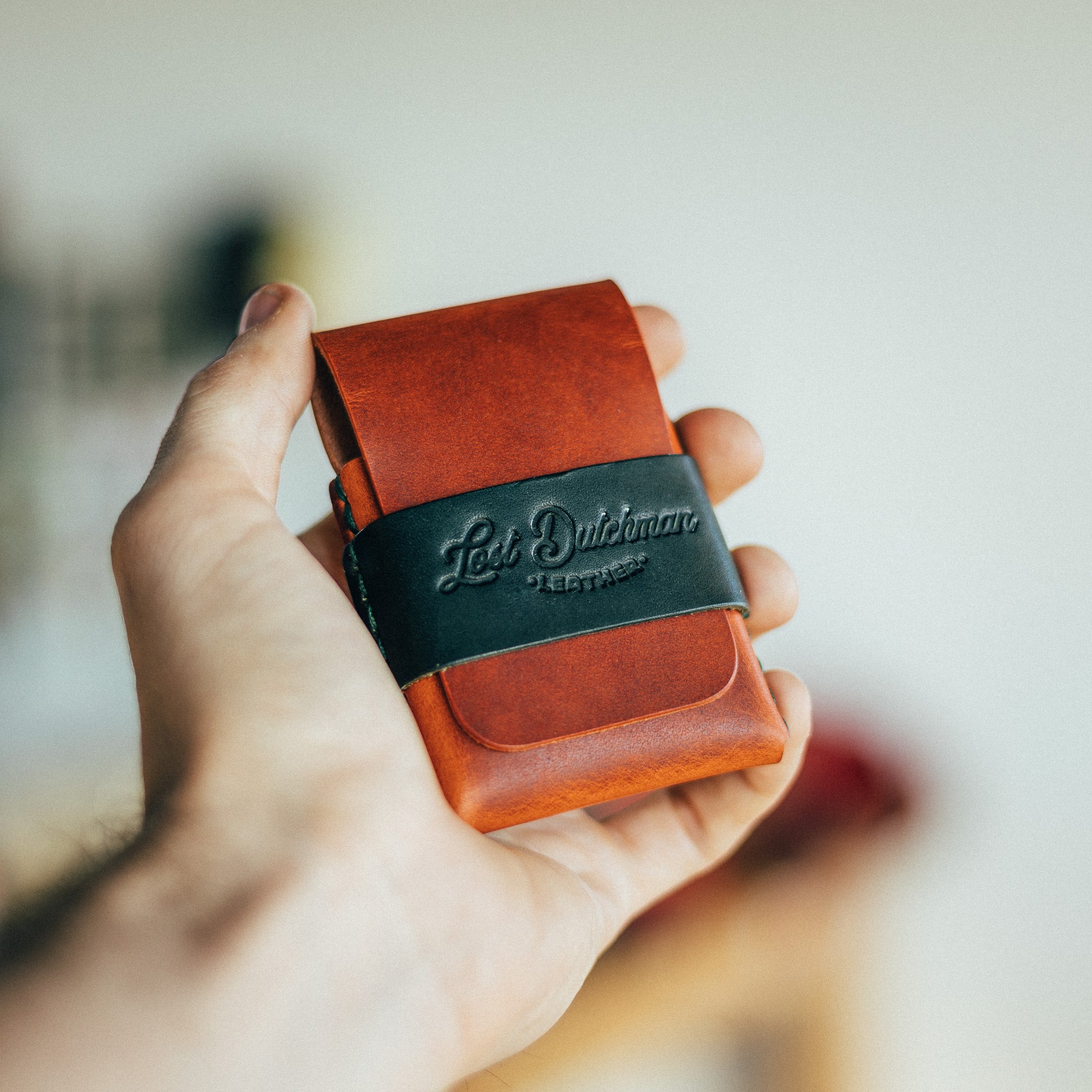
Lost Dutchman Leather builds men's compact wallets around this principle: maximum utility, minimum footprint. Full-grain leather construction ensures durability that synthetic materials can't match, while thoughtful pocket placement keeps essentials organized without layers of unnecessary fabric.
The Engineering Behind Compact Design
True compact design isn't about shrinking a traditional wallet. It requires rethinking how men actually use their wallets throughout the day.
Traditional bifolds create bulk through redundant layers. Two parallel card slots require four layers of leather even when empty. Add cash pockets, ID windows, and coin compartments, and the stack grows to eight or more layers in the center fold.
Compact wallets reduce this layering through vertical card arrangement and strategic material placement. A slim men's wallet profile emerges from eliminating overlap rather than using thinner materials that compromise longevity.
The math is straightforward. Six cards stacked vertically measure 3.5mm thick. Those same cards in traditional horizontal slots with leather separators measure 12-15mm. That 70% reduction in thickness transforms pocket carry from noticeable to invisible.
Material Selection Determines Long-Term Performance
Wallet compactness means nothing if the leather stretches after three months of use. Full-grain leather maintains its shape because the fiber structure remains intact - no sanding, no buffing, no correction.
This matters for men's compact wallets specifically because daily use patterns include frequent pocket carry. Men's wallets typically see consistent opening and closing, regular card turnover, and exposure to varied environments from back pockets to jacket pockets to briefcases.
Top-grain leather, the most common alternative, undergoes surface correction that weakens structural integrity. Within six months, card slots loosen and edges curl. The wallet that started slim becomes floppy and expands unpredictably.
Vegetable-tanned leather adds another performance dimension. Chemical tanning produces consistent color but creates leather that ages poorly. Vegetable tanning uses natural tannins that allow the leather to develop a patina - that rich, burnished character that improves rather than deteriorates over time.
The practical benefit? A vegetable-tanned wallet maintains its compact form for years rather than months. The leather actually becomes more supple while retaining structural memory.
Card Capacity Without Card Bulk
The standard man carries 8-12 cards daily. Credit cards, debit cards, insurance cards, driver's license, transit passes, and membership cards all compete for space. Compact wallets handle this load through layered accessibility.
Primary cards - those used multiple times daily - occupy front-facing slots with direct access. Secondary cards stack behind in slightly deeper pockets. This two-tier system reduces fumbling while maintaining quick retrieval.
Compare this to traditional slot arrangements where every card gets equal prominence. The result? A wallet that's 40% wider than necessary because it treats the grocery loyalty card with the same accessibility as the daily credit card.
Card holder designs take minimalism further by eliminating cash compartments entirely. For men who've transitioned to digital payments with occasional cash needs, this approach cuts wallet volume in half. A minimalist wallet for men measuring 3.9" × 2.7" × 0.3" holds six cards comfortably - the same capacity as a bifold twice its size.
The Franklin Wallet exemplifies this philosophy. Crafted from a single piece of leather without stitching, it holds 4-8 cards in a package that weighs 0.8 ounces. No bulk, no excess material, just essential function.
Cash Carry in Minimal Space
Digital payments haven't eliminated cash entirely. Farmers markets, tip jars, parking meters, and small vendors still require bills. Compact wallets accommodate cash without dedicated compartments through smart folding zones.
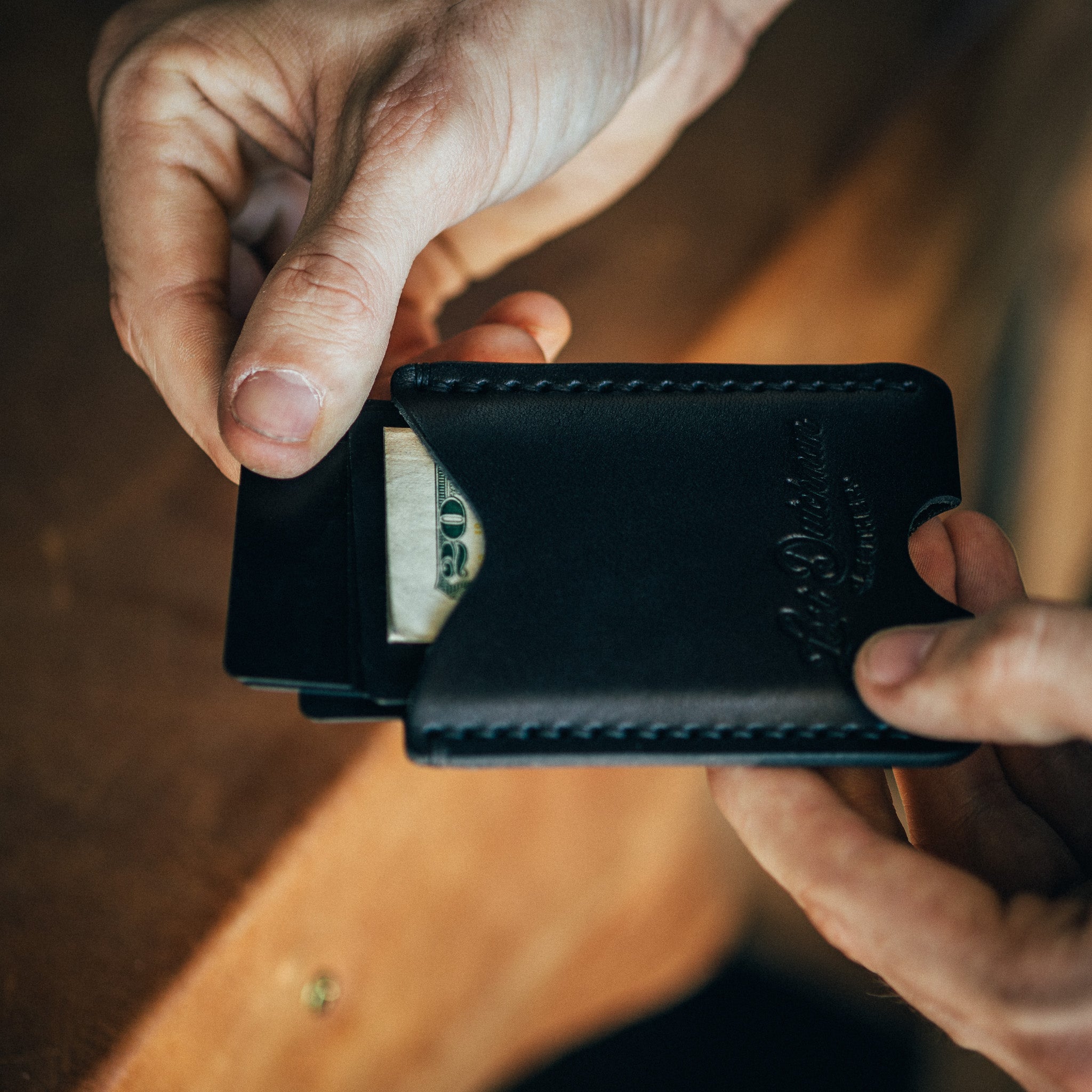
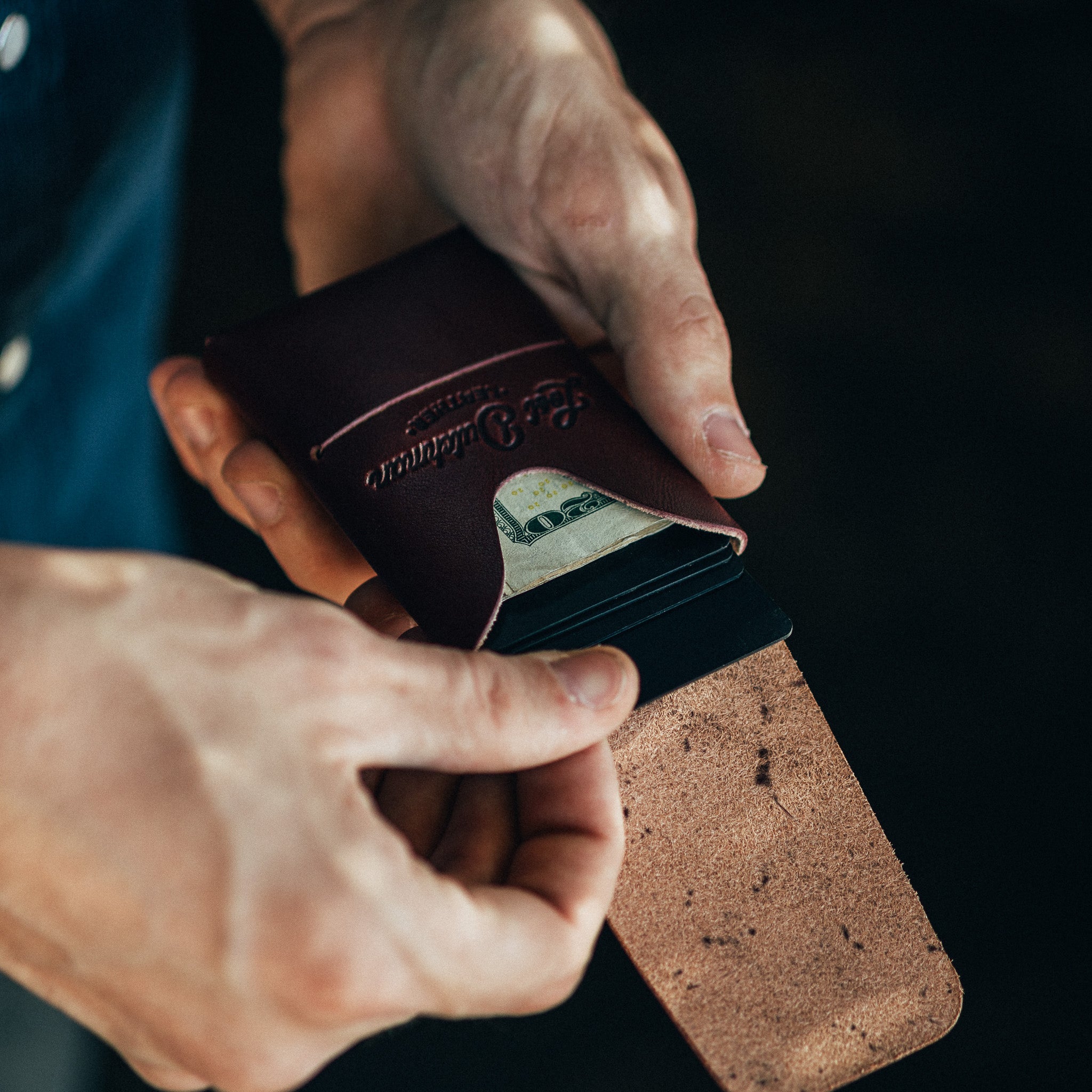
A center fold that extends slightly beyond card pockets creates a natural bill slot. Cash slides in flat, protected by the wallet's outer leather without requiring separate pocket construction. This design choice eliminates two layers of material while maintaining full cash functionality.
For men who carry cash regularly, bifold designs offer more structure. The key difference in compact bifolds lies in pocket depth and material thickness. Traditional bifolds use 2.5-3mm leather. Compact versions use 1.8-2.2mm leather without sacrificing durability because full-grain construction maintains strength at reduced thickness.
The Vertical Dutchman demonstrates this balance. Four card slots, one bill compartment, and an overall thickness of 0.4" when loaded with eight cards and folded bills. The vertical orientation fits naturally in front pockets or small crossbody bags - spaces where horizontal bifolds create awkward bulges.
Front Pocket Carry Changes Everything
Men's clothing offers deeper pockets than women's, but bulk still matters. Jeans pockets average 4" deep, yet a thick wallet creates uncomfortable sitting pressure and unsightly bulges. This reality makes front pocket compatibility essential for a durable men's wallet.
A front pocket wallet for men must meet three criteria: slim profile under 0.5" when loaded, smooth edges that don't catch on fabric, and balanced weight distribution that prevents tipping.
The profile requirement eliminates most traditional bifolds immediately. Even "slim" versions exceed 0.6" with normal card loads. Edge finishing matters more than most realize - rough-cut leather or exposed stitching snags on pocket linings, making retrieval frustrating.
Weight distribution affects comfort during movement. A wallet that's front-heavy tips forward in shallow pockets, while a back-heavy design pulls the pocket down. Centered weight - achieved through symmetrical card distribution - keeps the wallet stable during walking, sitting, and standing.
The Mini Franklin addresses these requirements at 3.5" × 2.5" × 0.3". It carries 2-6 cards and folded cash while weighing less than an ounce. The single-piece construction eliminates stitching that could catch, and the symmetrical design keeps weight centered.
Durability Standards for Daily Use
Compact doesn't mean delicate. Men's wallets endure significant stress - pocket friction, repeated opening, exposure to keys and coins, and temperature fluctuations from indoor to outdoor environments.
Saddle stitching outperforms machine stitching by a factor of ten in longevity. Machine stitching uses a single continuous thread - break one stitch and the entire seam unravels. Saddle stitching uses two threads that lock at each hole. Breaking one stitch affects only that single connection point.
This construction method matters particularly for compact wallets because reduced material thickness places greater stress on seams. A traditional bulky wallet distributes tension across multiple layers. A slim wallet concentrates that tension on fewer connection points.
Edge finishing protects against the daily wear that destroys lesser wallets. Burnished edges - where leather edges are compressed and polished rather than painted - resist moisture, prevent delamination, and maintain clean lines for years. Painted edges chip and peel within months.
The leather itself must resist stretching. Full-grain leather maintains dimensional stability because the natural fiber structure remains intact. Split leather and bonded leather lack this internal structure and expand with use, transforming a compact wallet into a shapeless pouch.
Organization Systems That Actually Work
A compact wallet fails if finding the right card takes twenty seconds of fumbling. Effective organization balances quick access with protective storage.
Staggered card slots - where each slot sits 3-4mm higher than the one behind it - allow visual identification without removing cards. This design feature, common in quality compact wallets, cuts retrieval time by 60% compared to uniform-height slots.
Color coding through leather accents provides another organizational layer. A wallet with different colored leather tabs for card sections - personal cards versus business cards, for example - enables one-handed operation. This matters when juggling shopping bags, phones, or coffee cups.
Minimalist wallets strip organization to its core: primary cards in front, secondary cards behind, cash in the center. No coin pouches, no receipt pockets, no loyalty card sections. This approach forces intentional carry - only items that earn their space make the cut.
The Dutchman exemplifies practical organization in a compact package. Four card slots arranged vertically, a center cash pocket, and an ID window - all in a bifold design that measures 4.4" × 3.5" × 0.4" when loaded. Each element serves a specific daily function without redundancy.
Breaking Points of Cheap Compact Wallets
The market overflows with "slim wallets" that fail within months. Understanding common failure points separates temporary solutions from long-term investments.
Synthetic materials compress permanently. That sleek RFID-blocking wallet that measured 0.3" new expands to 0.6" after six months because the synthetic fabric loses memory. The cards create permanent indentations that trap dirt and moisture.
Bonded leather - leather scraps glued together with polyurethane - delaminates at stress points. The corners separate first, followed by the fold line, until the wallet literally falls apart. Marketing calls it "genuine leather" because it contains leather particles, but performance resembles cardboard.
Inadequate stitching represents the most common failure point. Machine stitching with thin thread cuts costs but creates weak seams. Normal opening and closing stress breaks threads within 8-12 months. The wallet doesn't fail catastrophically - it slowly unravels.
Edge coating rather than edge finishing looks clean initially but chips away with use. Within three months, the painted edges show white underlayers. Within six months, the coating peels in strips, catching on pockets and looking shabby.
The Patina Factor in Long-Term Aesthetics
Quality compact wallets improve visually with age through patina development. This natural darkening and richening of leather occurs as oils from hands, environmental exposure, and UV light interact with the leather's tannins.
Vegetable-tanned full-grain leather develops the most dramatic patina. A natural-colored wallet starts honey-toned and evolves toward deep amber or cognac over 2-3 years of daily use. High-touch areas - card slots, fold lines, corners - darken faster, creating an organic contrast pattern unique to each user.
This aging process requires leather that hasn't been heavily finished. Chrome-tanned leather with thick polymer coatings can't develop patina because the protective layer prevents natural oils from penetrating the surface. The wallet looks the same at year three as day one - until the coating cracks and the wallet looks worn rather than aged.
The practical benefit extends beyond aesthetics. Patina development indicates healthy leather that's absorbing and releasing moisture naturally. This moisture regulation prevents cracking and maintains suppleness. A wallet that patinas well will last decades rather than years.
Transitioning From Traditional to Compact
Moving from a traditional wallet to a compact design requires intentional editing. The average man's wallet contains 23 items. A minimalist wallet for men comfortably holds 8-12.
Start by separating daily essentials from occasional needs. Cards used weekly or less don't belong in a daily carry wallet. Store them separately - in a car, desk drawer, or secondary wallet that stays in a bag.
Receipts, expired coupons, and loyalty punch cards add bulk without value. Digital alternatives exist for most loyalty programs. Receipts can be photographed and discarded immediately. These paper items often double wallet thickness while serving no daily function.
Cash carrying habits may need adjustment. Compact wallets handle 4-8 bills comfortably. More than that creates bulk and defeats the purpose. For situations requiring more cash, a separate money clip or small envelope serves better than forcing a compact wallet to behave like a traditional one.
The transition period lasts 2-3 weeks. During this time, the instinct to reach for cards that aren't there will occur. After three weeks, the edited carry becomes automatic, and the benefits of reduced bulk become obvious.
Compact Wallets for Different Lifestyles
Professional environments often require ID badges, multiple business cards, and corporate credit cards alongside personal items. A compact wallet for this context needs 6-8 card slots with clear organization between personal and professional items.
The Vertical Dutchman serves this need through its four front-facing slots and additional interior pockets. Business cards occupy the rear section, personal cards stay front and center, and the vertical format fits professional attire pockets naturally.
Minimalist lifestyles pair well with ultra-slim card holders. Men who've embraced digital payments, mobile IDs where legal, and minimal cash carry can reduce to 3-4 essential cards. The Franklin Wallet supports this approach with its 4-8 card capacity and 0.8-ounce weight.
Active lifestyles demand security beyond traditional pocket carry. Compact wallets for running, hiking, or cycling need attachment points or lanyard compatibility. Some designs incorporate snap closures or elastic bands to prevent cards from sliding out during movement.
Travel creates unique demands - passport carry, foreign currency, and multiple payment cards for different countries. A compact travel wallet prioritizes security features like RFID blocking while maintaining organization across currency types.
The True Cost of Quality
A $20 wallet replaced annually costs $200 over ten years, plus the hassle of repeated shopping and break-in periods. A $150 quality wallet lasting 15+ years costs less per year while delivering superior daily experience.
Full-grain leather wallets from makers like Lost Dutchman Leather fall into this buy-it-for-life category. The initial investment reflects material costs - quality hides cost 5-10 times more than corrected leather - and construction methods that require skilled hand-stitching rather than automated production.
The per-use cost calculation reveals the value. A wallet used twice daily for ten years sees 7,300 uses. A $150 wallet costs $0.02 per use. A $30 wallet lasting 18 months costs $0.03 per use - and that's before accounting for the frustration of premature failure.
Beyond mathematics, quality leather wallets eliminate decision fatigue. Buying once means never browsing wallet sections again, never comparing reviews, never wondering if the next option might be better. The decision is made, the item performs, life continues.
Care Requirements for Longevity
Compact wallets in full-grain leather require minimal maintenance but benefit from occasional attention. The leather's natural oils provide inherent protection, but environmental factors gradually dry the material.
Conditioning once every 6-12 months maintains suppleness. A small amount of leather conditioner - about the size of a pea - rubbed into the leather with a soft cloth restores oils and prevents cracking. Over-conditioning causes limpness and attracts dirt, so less is more.
Avoid water exposure when possible. While quality leather handles occasional moisture, repeated wetting and drying cycles stress the fibers. If the wallet gets wet, let it air dry naturally away from heat sources. Never use a hair dryer or place it on a radiator - rapid drying causes cracking.
Storage between uses matters less for daily carry wallets, but for occasional-use wallets, store them flat in a cool, dry place. Avoid plastic bags that trap moisture. A cloth dust bag allows air circulation while protecting from scratches.
The natural patina development requires no special care - it happens automatically through normal use. Trying to accelerate patina through oils or treatments usually creates uneven coloring that looks artificial rather than naturally aged.
Why Compact Matters Beyond Convenience
The shift toward compact wallets reflects broader changes in how men approach possessions. Minimalism isn't about deprivation - it's about intentionality. Carrying less means knowing exactly what's carried and why.
A slim men's wallet forces this intentionality. There's no room for "just in case" items that never get used. Every card, every bill must justify its presence. This editing process extends beyond the wallet into other areas - bags that are easier to carry, pockets that actually function, less time searching for items.
The physical benefits are measurable. Smaller wallets reduce back pocket bulk, which reduces sitting discomfort and potential back issues. Front pocket carry becomes more practical, eliminating the security concerns of rear pocket placement. Compact sizes fit suit jacket pockets and gym shorts without creating obvious bulges.
The psychological impact runs deeper. A streamlined wallet represents control over possessions rather than being controlled by them. It's a daily reminder that quality matters more than quantity, that thoughtful choices beat default accumulation.
Conclusion
Men's compact wallets prove that capacity and minimalism aren't opposing forces. Through strategic design, quality materials, and thoughtful construction, these wallets hold everything needed for daily life without the bulk that traditional designs create unnecessarily.
Full-grain leather construction provides the durability required for items used multiple times daily over many years. Vegetable tanning ensures the leather ages beautifully rather than simply wearing out. Hand-stitching and proper edge finishing prevent the premature failures that plague cheaper alternatives.
The transition from traditional to compact requires intentional editing, but the benefits - reduced bulk, improved organization, front pocket compatibility - justify the adjustment period. A well-designed compact wallet serves professional environments, active lifestyles, and minimalist preferences equally well through focused functionality.
Quality compact wallets represent investments rather than purchases. The higher initial cost divides across years or decades of daily use, delivering superior per-use value while eliminating the frustration of repeated replacements. The patina that develops over time creates a unique aesthetic that improves rather than deteriorates.
For men seeking wallets that respect both their daily needs and their desire for streamlined carry, compact designs built from quality materials offer the optimal solution. These aren't compromises - they're refinements that prove less can genuinely be more when executed with skill and attention to detail.
Explore Lost Dutchman Leather's full collection of leather accessories to find compact designs built for decades of daily use, or contact us for guidance on selecting the right compact wallet for specific needs.